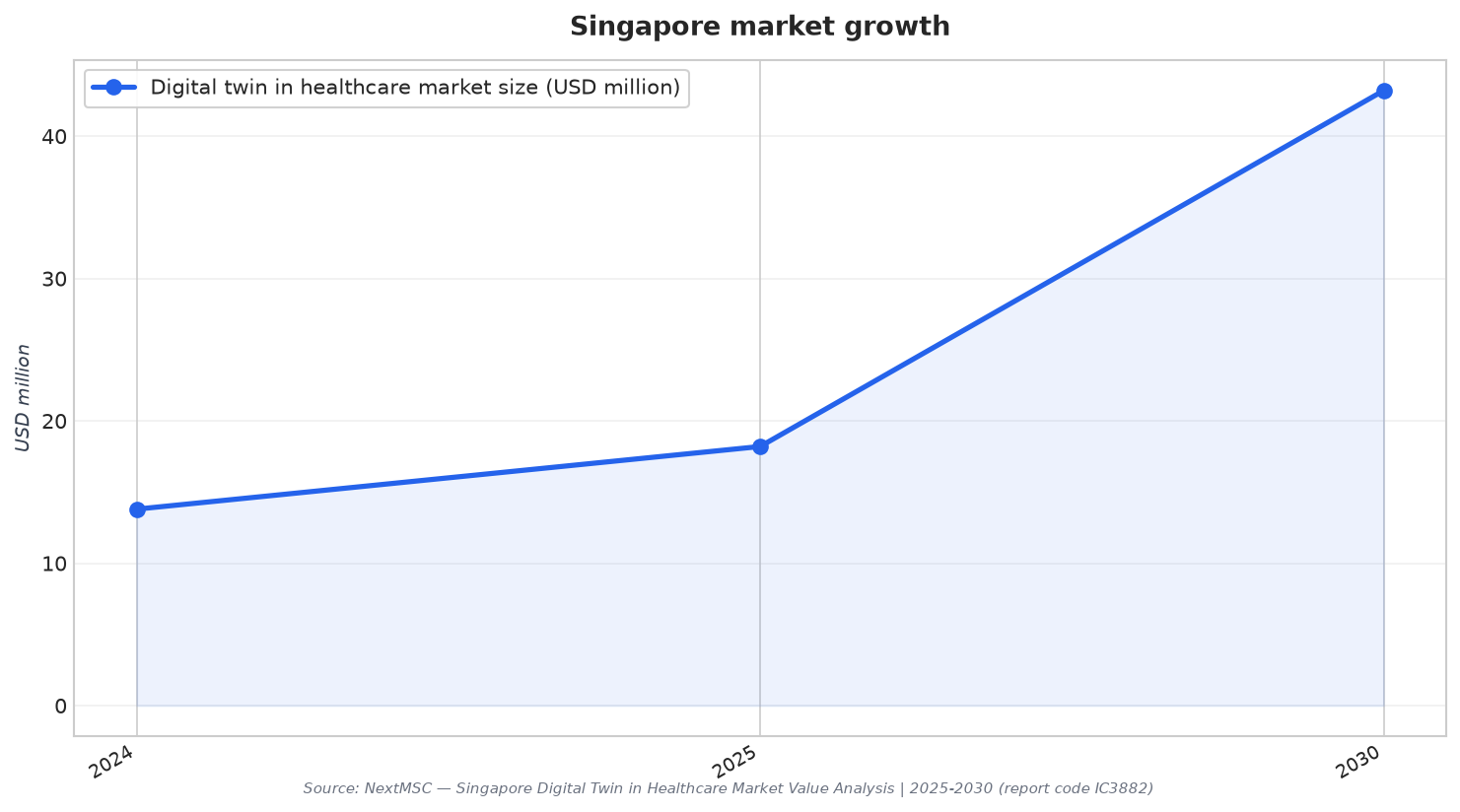
Hospital digital twins in Singapore are increasingly being positioned as an operational planning tool rather than a future concept. A Singapore-focused market analysis values the country’s digital twin in healthcare market at USD 13.8 million in 2024, with expectations of USD 18.2 million by 2025 and USD 43.2 million by 2030, reflecting a projected CAGR of 18.9% from 2025 to 2030. The same source links adoption to practical hospital needs, including simulating patient flows, monitoring medical equipment, optimizing resource allocation, and improving operational efficiency. It also highlights ongoing barriers, including high implementation costs and integration challenges, which can affect the pace of rollout across facilities.
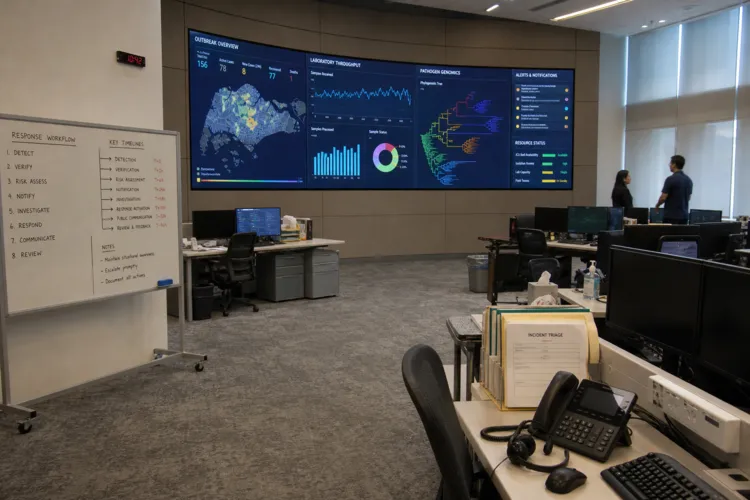
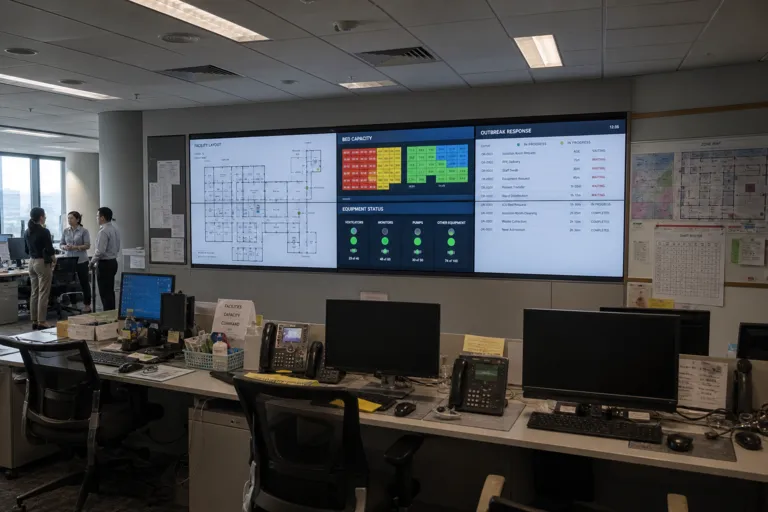
In Singapore’s public system, SingHealth’s work illustrates how the technology shifts planning from periodic reviews to continuous, data-linked decision support. At HealthTechX Asia 2026, Changi General Hospital’s Chief Data and Digital Officer, Dr. Chow Weien, said the SingHealth cluster is leveraging digital twins for real-time surveillance and predictive decision-making. SingHealth began its project after the COVID-19 pandemic exposed latency in traditional outbreak investigations, which often required manual extraction of data and resource-intensive spatial analysis. In 2020, SingHealth started a proof of concept for a Three-Dimensional Disease Outbreak Surveillance System (3D-DOSS) that integrated anonymised patient data onto digital replicas of Singapore General Hospital’s physical space. After that proof of concept, SingHealth launched the Four-Dimensional Disease Outbreak Surveillance System (4D-DOSS) for geospatial tracking of infectious diseases across time, integrating with bed management, lab, and clinical systems.
Why Digital Twins Change the Way Hospitals Plan Day to Day
The planning value comes from connecting “live” operational inputs to a virtual replica that can surface patterns that are hard to see in spreadsheets and static layouts. Dr. Chow described hospitals as dynamic environments where patients and staff constantly move, making manual pattern detection difficult with two-dimensional tools. Meanwhile, the Singapore market analysis frames common operational uses in more traditional hospital management terms: predicting patient demand, managing ICU capacity, simulating admissions, optimizing staffing, and scheduling medical equipment maintenance. It also points to integration of IoT-enabled devices, AI-driven analytics, and cloud computing as enabling predictive maintenance, real-time monitoring, and improved clinical decision-making. In this view, digital twins are not only about modelling; they help reduce downtime, manage emergencies, and streamline workflows when demand is high.
Singapore’s broader digital-twin and smart-infrastructure agenda provides context for why these hospital use cases can move quickly from concept to deployment. Virtual Singapore is described as a national digital replica effort supported by a 2014 national 3D mapping project launched by the Singapore Land Authority. That mapping work collected more than 50 terabytes of data, covered the country’s 5,500 km road network, and captured over 3 million images and 600 million LiDAR points, with a cited modelling accuracy of 0.3 metres. The Virtual Singapore platform is described as a SGD 73 million initiative led by the National Research Foundation. For hospitals, the takeaway is less about city planning and more about the operational precedent: large-scale digital replicas can be built on shared data foundations and then connected to real-time feeds and agency systems.
Within this environment, the Hospital Digital Twins Singapore trend signals an operational planning shift toward simulation-led choices on capacity, staffing, and asset utilization, anchored in continuously updated data. Regional and global context aligns with this direction. An Asia-Pacific analysis states that Japan, Singapore, and South Korea are leading with AI-driven simulations and advanced medical infrastructure, and notes that hospitals in the region use digital twins to simulate operations, optimize patient flow, and reduce treatment delays. A separate industry view emphasizes that healthcare payers and providers are primary users because they can apply digital twin platforms directly to simulate patient flow, improve capacity management, and optimize staffing. Taken together, these signals point to hospitals treating digital twins as a core planning capability, while still needing to address cost and integration realities called out in Singapore’s market outlook.
What is driving hospital digital twin adoption in Singapore?
How did SingHealth apply digital twins to outbreak surveillance?
What market figures are reported for Singapore’s digital twin in healthcare sector?
What challenges can slow down digital twin deployments in hospitals?
How are Hospital Digital Twins in Singapore changing operational planning?