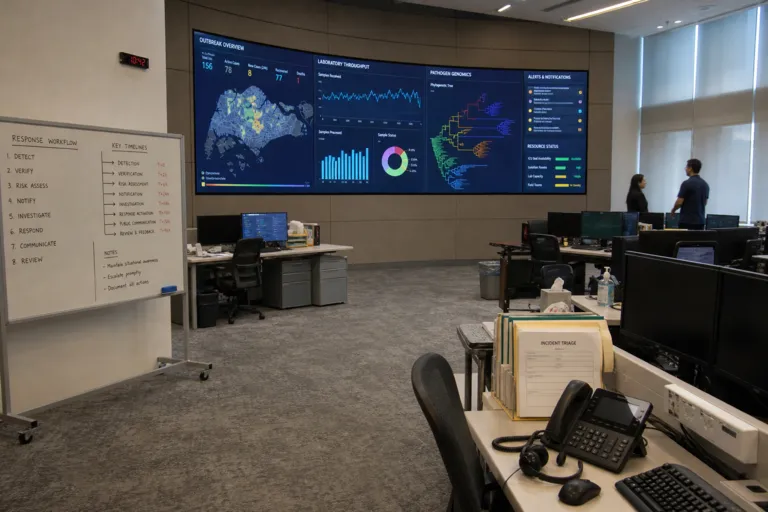
In Singapore, outbreak readiness is increasingly being framed as a data problem as much as a clinical one. The Communicable Diseases Agency (CDA), established in April 2025, is exploring artificial intelligence to enhance infectious disease surveillance and outbreak response, according to CDA chief executive officer Vernon Lee. He said AI can complement existing surveillance strategies by scanning international disease reports to help detect and assess potential outbreaks. The approach aligns with Singapore’s pandemic preparedness framework and its push to stay connected to global surveillance systems that provide early warnings when infectious diseases emerge.
That drive for earlier warning is also shaping a new regional platform called PathGen, which was unveiled publicly on Dec 1, 2025. The tool is being developed by the Duke-NUS Centre for Outbreak Preparedness with support from Temasek Foundation, the Gates Foundation, and the Philanthropy Asia Alliance. It aims to integrate and analyze pathogen genetic data alongside other sources such as clinical information, mobility patterns of humans and animals, and climate data. The Straits Times reported that this combination could detect emerging disease threats earlier than traditional surveillance methods and guide decisions on treatments, vaccines, and resource allocation during outbreaks.
From Signals to Parameters: What “Real-Time” Can Mean
PathGen’s ambition is not only to spot signals, but to estimate practical outbreak parameters that responders need quickly. At the Dec 1 preview, Singapore’s Minister for Health Ong Ye Kung said there is a one-in-three chance of another pandemic like Covid-19 occurring in the next two decades. He added that preparedness involves taking early action to anticipate and plan how to keep infection, severity, and fatality rates low during a pandemic. In this context, PathGen could estimate incubation periods, reproduction numbers, mobility rates, transmission modes, vulnerable population segments, and predict outbreak trajectories—parameters Ong said Singapore initially had “no clue” about when Covid-19 arrived.
Singapore’s approach also emphasizes co-development and phased deployment. Temasek Foundation’s executive director and chief executive Ng Boon Heong said PathGen will be co-created with partners from six South-east Asian countries: Indonesia, Malaysia, Philippines, Thailand, Vietnam, and Singapore. The platform is expected to move from proof-of-concept to a launch-ready version over the next 18 months, with pilots from early 2026 and a phased roll-out through 2027. This is positioned as a shared public good intended to strengthen regional health security rather than a single-country system.
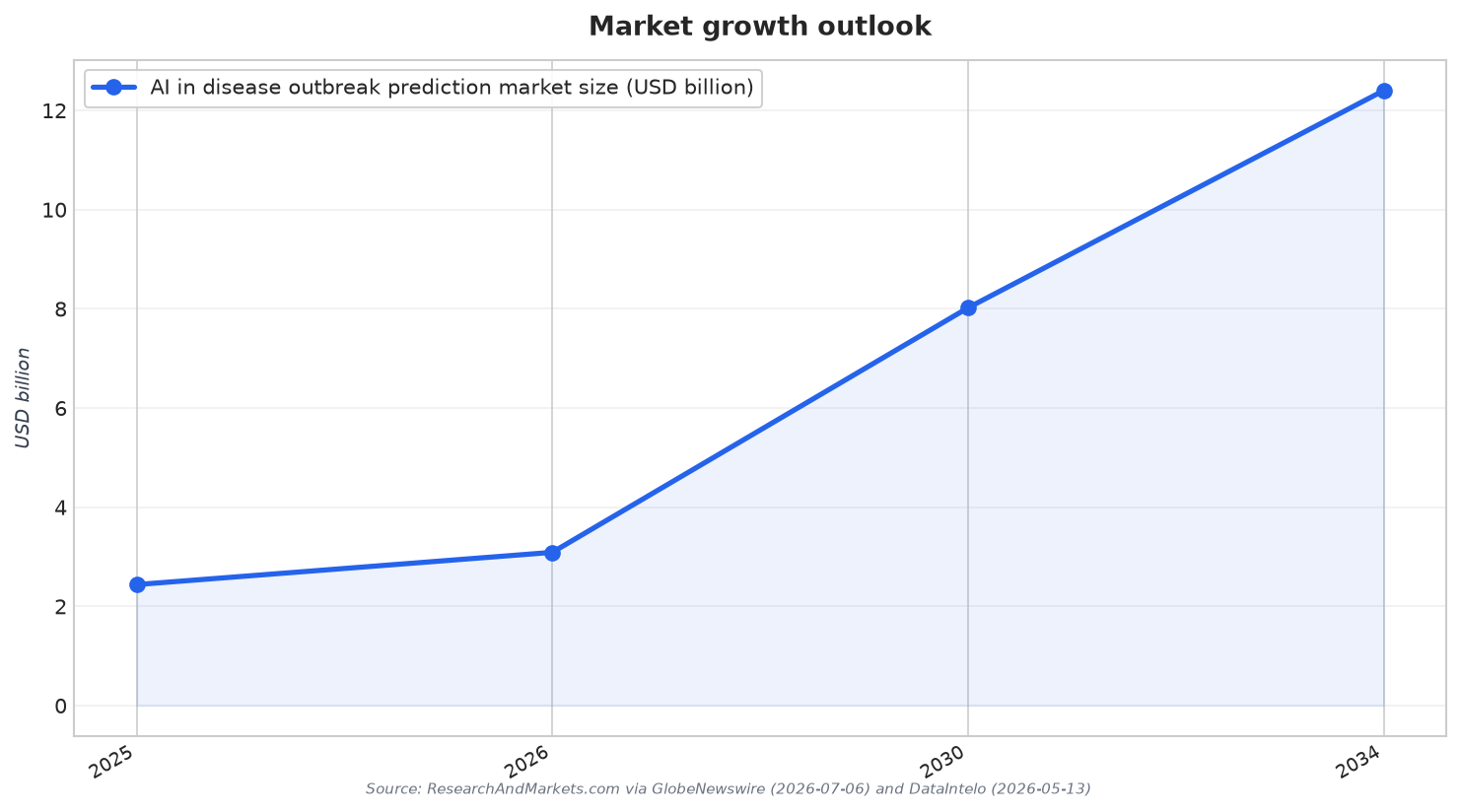
Wider AI investment trends provide context for how quickly predictive tooling is advancing. One market report valued the global Disease Outbreak Prediction AI market at $2.8 billion in 2025 and projected $12.4 billion by 2034, reflecting an 18.9% CAGR. A separate market report projected growth from $2.44 billion in 2025 to $3.09 billion in 2026, and to $8.02 billion by 2030. In Singapore’s ecosystem, Google announced a coordinated five-program healthcare AI deployment across the public health system and a $7 million philanthropic commitment that includes $1 million for PathGen. Together, these moves frame how Disease Outbreak Intelligence AI Singapore efforts are being connected to both national operations and cross-border early warning goals.
How is Singapore’s Communicable Diseases Agency using AI for surveillance?
What data sources does PathGen plan to analyze?
When will PathGen be piloted and rolled out?
What did Singapore’s Health Minister say about the risk of another pandemic?
How does Disease Outbreak Intelligence AI in Singapore connect to PathGen funding?