Health Worker Shortage APAC pressures are becoming a core driver of how care models evolve. Healthcare Asia Magazine points to a global shortfall of 11 million healthcare workers by 2030, while the World Economic Forum said healthcare inflation across the region may have exceeded 12% in 2025. Even when spending rises, the same report notes outcomes can vary significantly within economies, often linked to where people live rather than the care they require. This mix of workforce scarcity and cost strain makes AI clinical support less about experimentation and more about preserving capacity, standardizing decisions, and keeping access workable across fragmented delivery networks.
New survey data underscores why clinical support demand is shifting from “nice to have” to operational necessity. Bain & Company’s 2026 Asia-Pacific Front Line of Healthcare Report, based on surveys of 6,300 consumers across nine Asia-Pacific markets and 600 doctors in the region, says systems are approaching an inflection point where rising demand, workforce scarcity, and fragmented care models converge. On average, 57% of consumers report receiving care in at least one alternative setting such as telehealth, urgent care clinics, walk-in clinics, home-based care, and ambulatory surgery centers. Meanwhile, 95% of respondents want a single touchpoint to manage healthcare, up from 70% in 2019. That combination pulls AI toward navigation, triage, and decision support that can follow the patient across settings.
What AI Clinical Support Looks Like When Workforce Capacity Is Tight
Across Asia-Pacific, practical use cases already show how AI can reshape clinical support demand by removing bottlenecks. Healthcare Asia Magazine highlights AI-powered screening platforms delivering results, plus remote patient monitoring, digital therapeutics, and consumer health technologies that reduce avoidable admissions and emergency visits. The same source describes remote-controlled ultrasound in Japan and Taiwan, enabling specialists to diagnose patients hundreds of kilometres away and reducing travel and wait times. It also cites Singapore’s shared national imaging platforms, which process tens of thousands of cases a month and prioritize urgent cases in seconds rather than days. These examples point directly to clinical decision support, prioritization, and remote expertise extension—areas that become more valuable as staffing constraints worsen.
Clinician strain also clarifies which AI tools will be demanded first: those that reduce low-value work and workflow friction. Bain reports one in five doctors are actively considering leaving their current employer, driven mainly by excessive workload, lack of recognition, and burnout. Around one in three doctors report significant waste and inefficiency in daily work, including excessive forms and paperwork, low-value repetitive tasks, and delays from fragmented workflows and coordination gaps. In that context, “clinical support” increasingly means workflow automation, documentation relief, and smarter coordination rather than only advanced diagnostics. This aligns with Polaris Market Research, which describes physician shortages as accelerating workflow automation demand to improve clinical decision-making and automate workflows.
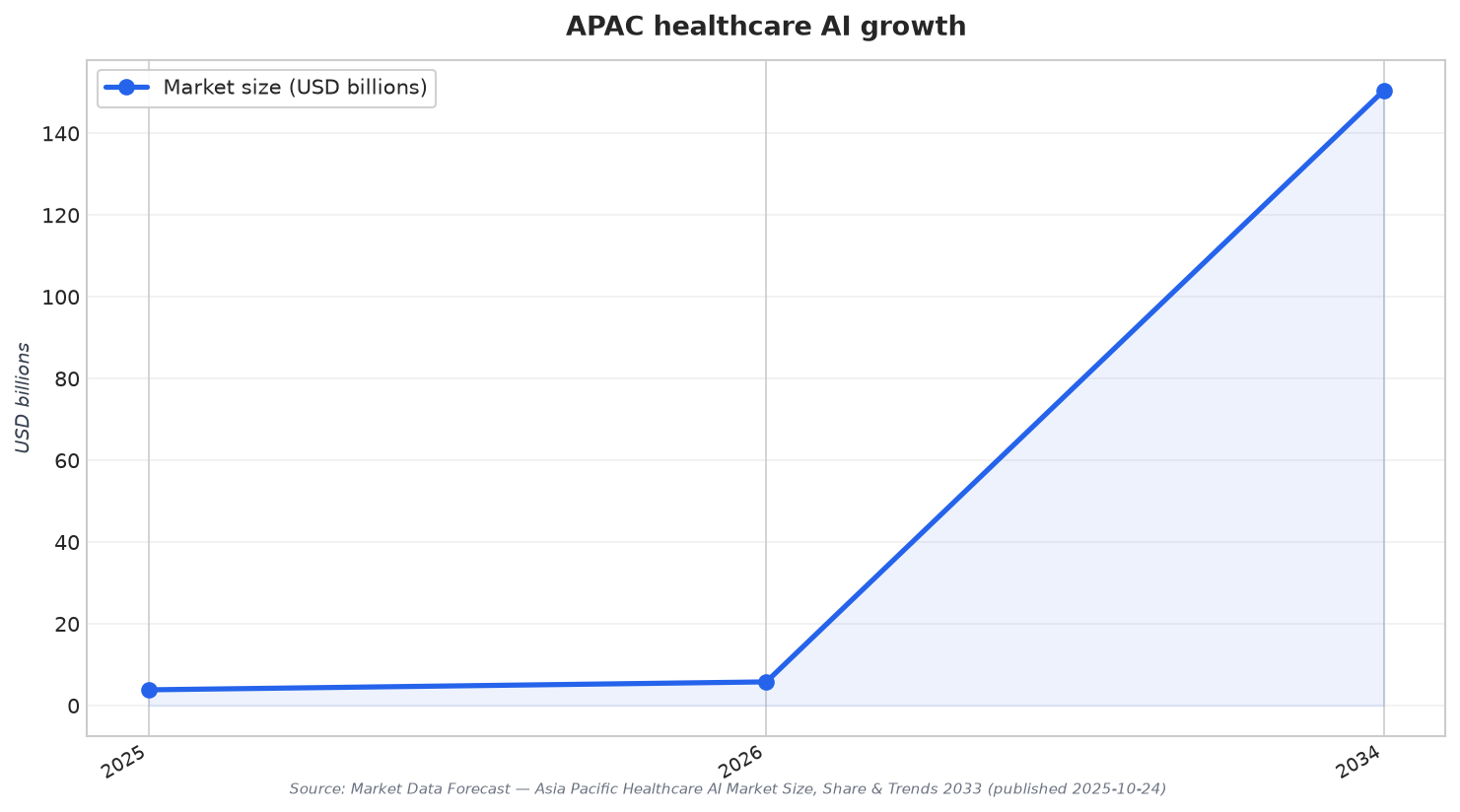
Market forecasts reflect how quickly budgets and roadmaps could pivot toward AI-enabled support across the region, even while adoption remains challenging. MarketsandMarkets values the Asia Pacific AI in healthcare market at $21.63 Million in 2025 and projects $110.61 Million by 2030, citing a 38.6% CAGR and noting adoption across diagnostic imaging, drug discovery, and clinical decision support systems. A separate forecast from Market Data Forecast values the Asia Pacific healthcare AI market at USD 3.86 billion in 2025, estimates USD 5.80 billion in 2026, and projects USD 150.45 billion by 2034 with a 50.23% CAGR (2026–2034). Healthcare Asia Magazine cautions that progress depends on aligning incentives, regulation, and investment—suggesting that AI demand may grow fastest where leaders can make readiness match capability.
How could the health worker shortage across APAC reshape demand for AI clinical support?
What signals show clinician workload is becoming a catalyst for AI adoption in the region?
Which real-world AI-enabled clinical support examples are already cited in Asia-Pacific?
What do the sources say about Asia-Pacific AI in healthcare market growth?