

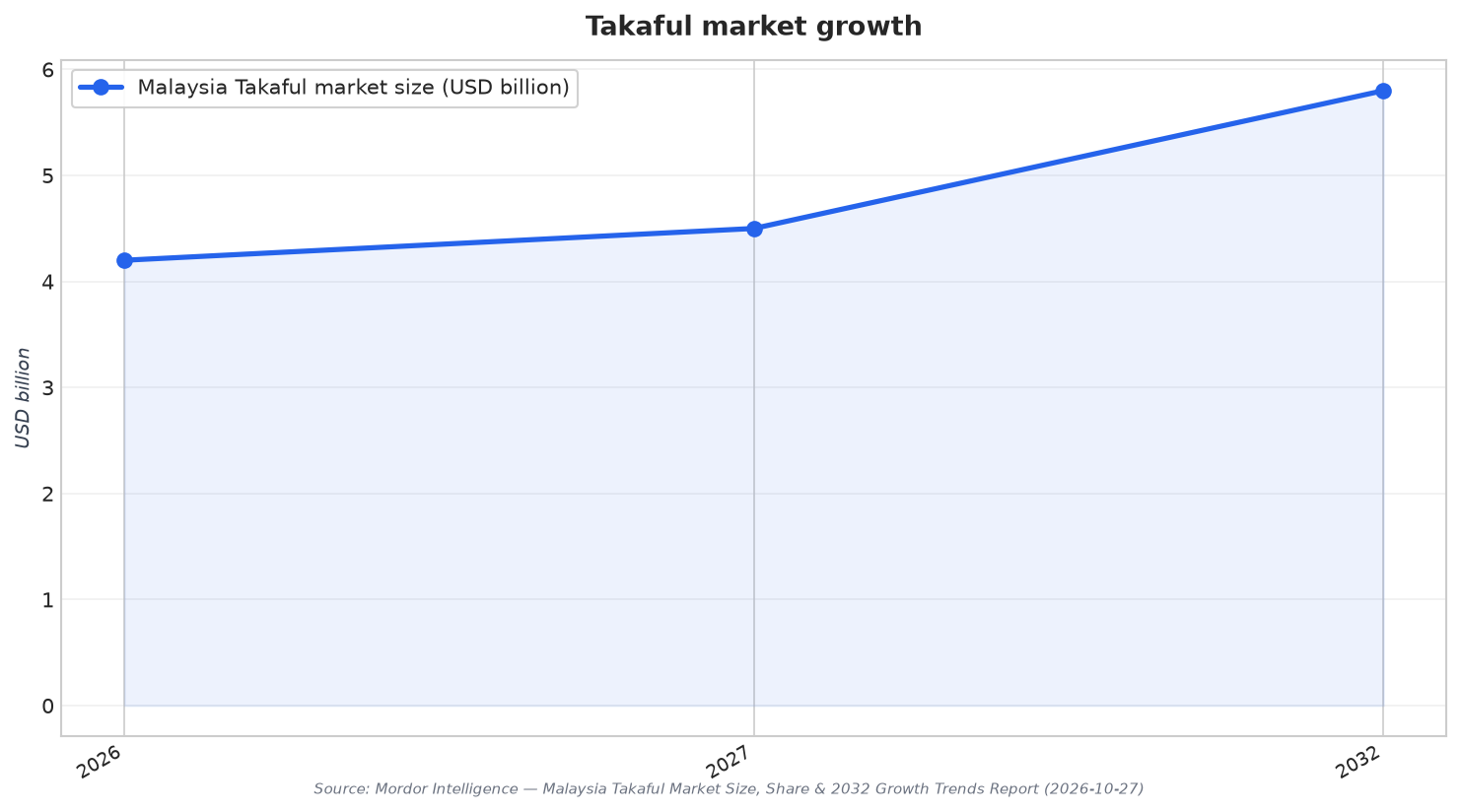
Takaful Health Insurance Malaysia is being shaped by two forces moving at the same time: market expansion and affordability strain. Mordor Intelligence projects the Malaysia Takaful Market to expand from USD 4.20 billion in 2026 and USD 4.5 billion in 2027 to USD 5.80 billion by 2032, registering a CAGR of 5.5% between 2027 and 2032. Contributions data also points to continued momentum. Net contributions in Malaysia’s takaful industry rose 9.8% to MYR 19.0 billion (USD 4.2 billion) in 2024, compared with MYR 17.3 billion in 2023, while 2025 gross contributions increased 4.73% to MYR 16.38 billion (USD 3.6 billion). However, the same growth environment is challenged by rising medical costs and claims that are putting pressure on affordability, pricing, and underwriting margins.
Those cost pressures are clearer in claims-level findings from the World Bank’s analysis of Malaysia’s centralized claims database covering 2022–2024. Total claims rose substantially across all major service categories, with particularly fast growth in pre-hospitalization and post-hospitalization claims. The report finds that cost growth is largely driven by volume (or utilization), accounting for three quarters of all cost growth, followed by higher service charge prices. It also notes the share of claim amounts due to hospital supplies and services (HSS) is over 70 percent and rising. On efficiency, about one-fourth of inpatient admissions are potentially preventable, measured at 23.6% in 2024, pointing to the value of longer-term strengthening of primary care through prevention, early detection, and chronic disease management.
RESET and the Push for Broader Access to Cover
Bank Negara Malaysia (BNM) is responding through its RESET reform agenda and a new standardised base medical and health insurance/takaful (MHIT) plan. According to reporting on the reform, BNM’s objective includes expanding access to cover for individuals with stable, controlled pre-existing conditions who often face difficulty obtaining any form of medical insurance or takaful. Under the framework, premiums remain age-based, but the curve between younger and older cohorts is intended to be flatter than in many existing products. Risk is pooled across all participating insurers and takaful operators, and there are limits on how much an individual’s health status can affect pricing, subject to regulatory oversight. BNM’s engagement across government bodies, private hospitals, doctors, insurers, takaful operators, and consumer groups has highlighted recurring themes of premium affordability, long-term sustainability, and alignment with broader health delivery reforms.
Distribution and balance-sheet capacity can influence how quickly inclusive design becomes real customer coverage. Mordor Intelligence reports that bancatakaful held 53.8% of Malaysia Takaful market share in 2026, positioning banks as a major pathway for retail protection. Central Malaysia accounted for 46.3% of market share in 2026, while East Malaysia is projected to grow at a 7.4% CAGR through 2032, suggesting regional expansion remains part of the coverage story. On financial strength, takaful industry assets reached MYR 62.54 billion (USD 13.9 billion) by mid-2025, up from MYR 41.87 billion (USD 9.3 billion) in 2020. The overall Malaysian insurance and takaful industry reported a capital adequacy ratio of 225% in the second half of 2025, above Bank Negara Malaysia’s 130% regulatory minimum, with excess capital of MYR 43.8 billion (USD 9.7 billion), though these capital figures apply to the combined industry rather than takaful operators alone.
Inclusion also depends on awareness and adoption, not just product design. A narrative review on takaful adoption in Malaysia argues that managing and improving public perception is crucial to raise awareness and participation. It also highlights boundary conditions: Kamarubahrin et al. (2020) found perceptions had only a weak effect on intentions toward mental-health takaful because awareness and education were low, and Salman and Kawata (2022) argued many Muslim consumers undervalue takaful relative to conventional insurance, while providers have been slow to adopt modern advertising channels. Taken together with RESET’s emphasis on more transparent and proportionate underwriting, the direction is clear: wider eligibility and pooled risk can help, but sustaining inclusive coverage will still require confronting utilization-driven cost growth and improving consumer understanding of how medical and health takaful works.
What is changing in Malaysia’s medical and health insurance/takaful under RESET?
What is driving recent cost growth in Malaysia’s MHIT claims data?
What does the evidence say about potentially preventable inpatient admissions?
How large is Malaysia’s takaful market expected to become by 2032?
How is Takaful Health Insurance Malaysia moving toward more inclusive coverage?