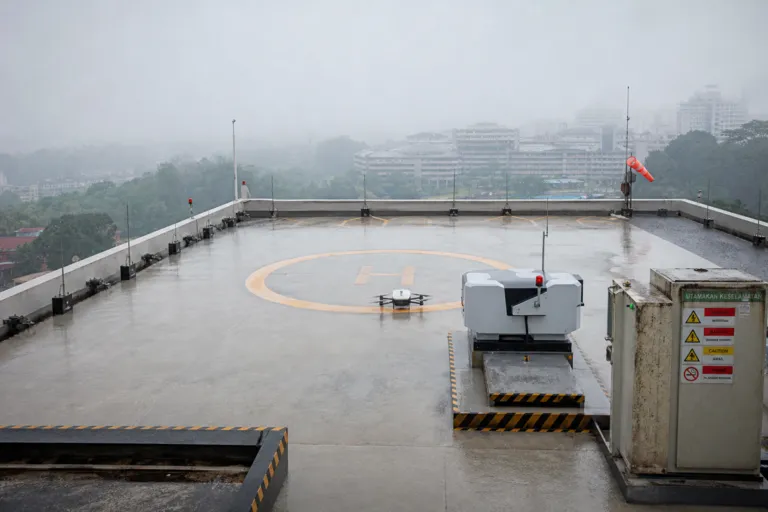
Hospital drone logistics in Malaysia is moving from a concept to a serious planning topic because drone delivery is already being framed as part of national adoption. A Malaysia-focused drone package delivery outlook describes government initiatives promoting autonomous delivery and smart city development, and it explicitly points to applications expanding beyond e-commerce into healthcare, emergency services, and industrial logistics. That same outlook expects Malaysia to emerge as Southeast Asia’s leading drone delivery market by 2029, which matters for hospitals because it signals broader ecosystem readiness rather than isolated pilots. It also lists emergency logistics and remote-area supply as installed and operated use cases, aligning naturally with emergency medical supply delivery needs.
To understand what could reshape emergency supply delivery, it helps to look at how the wider medical drone market is being quantified and segmented globally. Polaris Market Research values the global medical drones market at USD 419.42 million in 2025, projecting growth to USD 1,696.78 million by 2034 at a 16.8% CAGR from 2026–2034. In the same report, North America held 40.0% share in 2025, while Asia Pacific is expected to register a 17.4% CAGR. For emergency supply chains, the “blood bank transferring” segment dominated with a 39.8% share in 2025, reflecting how time-sensitive hospital logistics can anchor real-world demand for medical drone programs.
What Changes When Drones Plug Into Hospital and EMS Workflows
Emergency delivery is not only about aircraft. It is about repeatable service models that fit hospital and EMS operations. Global Market Insights estimates the medical drone delivery services market at USD 166.5 million in 2025 and expects a 29.1% CAGR during 2026 to 2035. It ties growth to increasing use of medical drones in healthcare and notes strong momentum for transporting supplies to hospitals and EMS systems, mainly for emergency medical logistics. As care models shift toward hub-and-spoke networks and decentralized care, the report positions drone-enabled logistics as a faster and more cost-efficient alternative to traditional ground transport for lab samples, blood products, specialty pharmaceuticals, vaccines, and other time-sensitive supplies.
Other global figures show how emergency response specifically is being operationalized where policies and authorizations exist. Dataintelo reports that Emergency Medical Services operators capture 8.7% of the end-user medical drone delivery market, integrating drones for pre-hospital supply chains, mass casualty incident response, and rural emergency access to critical medications and equipment. It also states that fire departments and emergency management agencies across 170+ jurisdictions have authorized routine drone operations for emergency supply delivery to scenes, achieving a 38% reduction in response time for advanced life support supplies. These figures are not Malaysia-specific, but they illustrate the measurable emergency performance targets Malaysian stakeholders may look to when building hospital-linked drone corridors.
For Hospital Drone Logistics Malaysia to reshape emergency supply delivery, the most credible near-term path is integration with hospital systems and governance models that make drones routine, not exceptional. Fact.MR notes that integrating medical drone delivery with hospital inventory management systems for just-in-time pharmaceutical and blood product supply can create recurring logistics service revenue models. Polaris also highlights the role of AI in autonomous flight planning, route optimization, obstacle avoidance, predictive maintenance scheduling, and real-time tracking and monitoring of shipments during transit. Paired with Malaysia’s stated push for autonomous delivery and smart city development, these operational building blocks can help hospitals plan for emergency readiness where ground transport is disrupted or too slow, while keeping focus on regulated, high-value medical payloads.
How could hospital drone logistics in Malaysia change emergency supply delivery?
What does the global medical drones market look like in dollars and growth?
Which medical delivery use case leads the market, according to the sources?
What evidence links drones to faster emergency response in other jurisdictions?
How big is the medical drone delivery services market, and how fast is it expected to grow?