
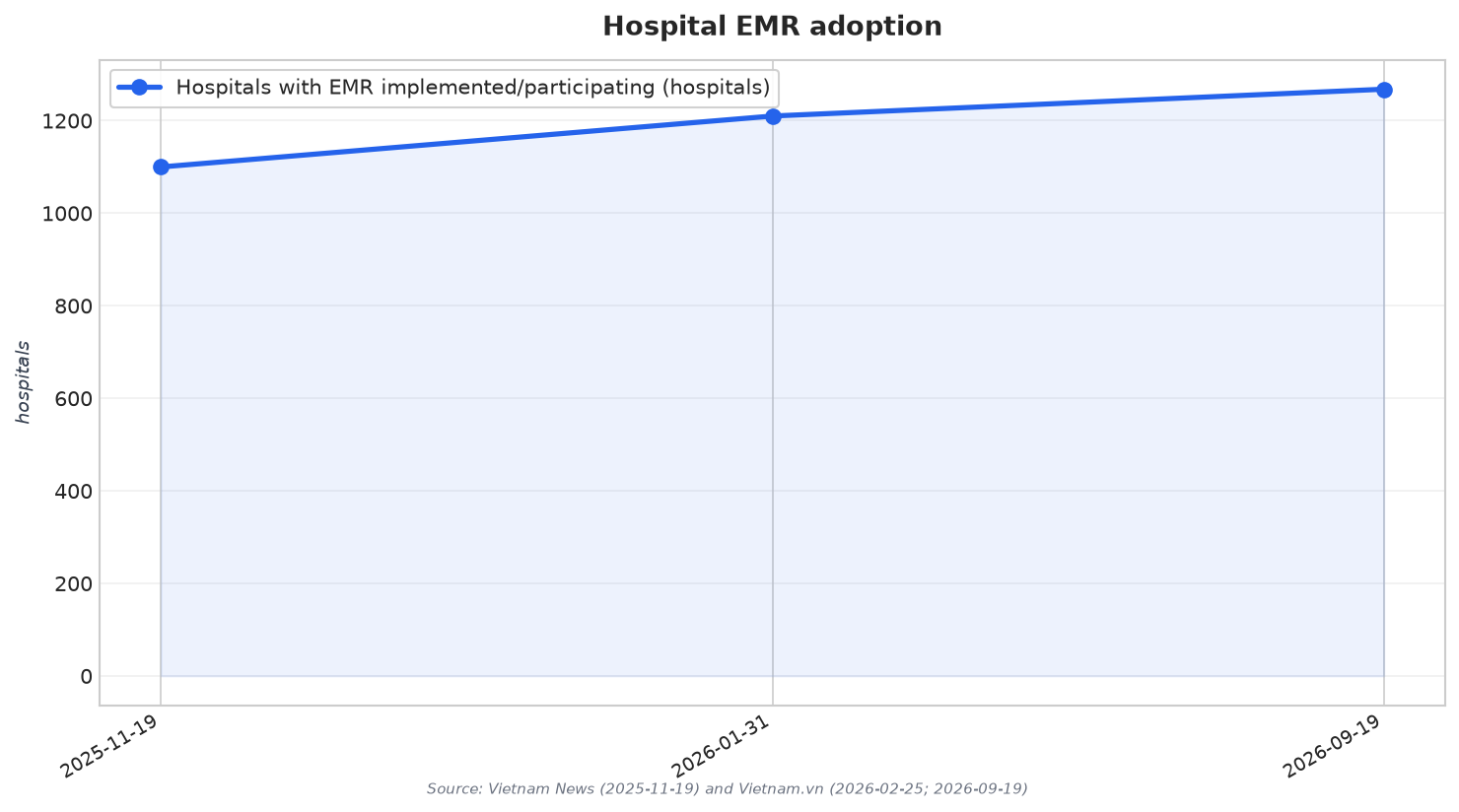
Vietnam’s nationwide push for electronic records is becoming more operational and more connected. By the end of January 2026, the electronic health record integrated into the VNeID application had been deployed nationwide, completing over 34 million electronic health records for citizens. A separate update said the rollout across all 34 provinces and cities covered approximately 30 million citizens, highlighting that deployment is broad while data completeness can vary. Alongside citizen-facing records, hospital digitisation is accelerating. Nearly two-thirds of medical facilities—more than 1,100 out of 1,650—have adopted electronic medical records, and a ministry update reported about 1,210 out of 1,650 public and private hospitals had announced EMR implementation.
This shift is also being framed as a compliance and operating deadline, not only a technology upgrade. Under the National Digital Transformation Program (Decision 749/QĐ-TTg), healthcare is a top-priority sector, with targets that include 100% of healthcare facilities adopting EHR, e-prescriptions, and cashless payments by 2025. Some analyses describe a 2025–2026 compliance window for EHR implementation, which increases pressure on hospitals to improve workflows, data capture, and integration. Vietnam’s system context adds urgency: one analysis describes care delivery for over 100 million people supported by around 1,645 hospitals nationwide, including 384 private hospitals.
From Coverage to Completeness: Integrating Routine Check-ups
A major gap is not whether records exist, but whether they include routine health information. On 10 March, a Ministry of Health meeting chaired by Deputy Minister Nguyen Tri Thuc advanced plans to connect routine health check-up data with the national electronic health record system. The National Health Information Centre said current records are drawn predominantly from health insurance and hospital treatment data, while routine check-ups and screenings at community health stations, workplaces, schools, and via mobile health units have not been systematically captured or linked to citizen profiles. Officials reviewed two technical options and indicated a preference for routing information through Vietnam Social Security’s data infrastructure, citing its established technical capacity and nationwide familiarity.
Government objectives are being tied directly to primary care and prevention. Deputy Minister Nguyen Tri Thuc said the goal is for every citizen to receive at least one health check-up per year, with the resulting data updated directly to the VNeID health record. He also noted localities are running health management programmes on disparate systems, reinforcing why a unified infrastructure matters. The expected outcome is a stronger national medical data repository to support clinical care, policy planning, and broader health-sector digitalisation. In parallel, Vietnam is also rolling out supporting platforms: on 31 December 2025, the Ministry of Health issued Decision No. 4048/QD-BYT to implement shared platforms nationwide, including an electronic health record platform and a platform for supporting remote medical consultation and treatment.
Progress is visible, but interoperability and capacity constraints remain central to the nationwide rollout. Vietnam has more than 18 providers of EMR software nationwide, while reports also describe compatibility differences and hospitals storing information in different formats. The Ministry of Health reported that as of September 19, 1,268 out of 1,650 public and private hospitals nationwide have participated in the EMR system, showing continued onboarding momentum. At the facility level, Vietnam News reported that 23 hospitals have fully switched to filmless diagnostic imaging. Market context signals sustained investment interest: one Vietnam brief estimated the digital healthcare market reaching USD 815 million in 2026 and growing to USD 1 billion by 2028 at a CAGR of 5.31%, while another analysis cited a government commitment of up to VND 30,000 billion (about USD 1.26 billion) to accelerate healthcare digitisation.
What is happening with National Electronic Health Records Vietnam as rollout expands?
How many hospitals are participating in electronic medical records in Vietnam?
What data is missing from many electronic health records today?
What target is Vietnam linking to annual check-ups and VNeID health records?
What policy target is cited for EHR adoption across healthcare facilities?