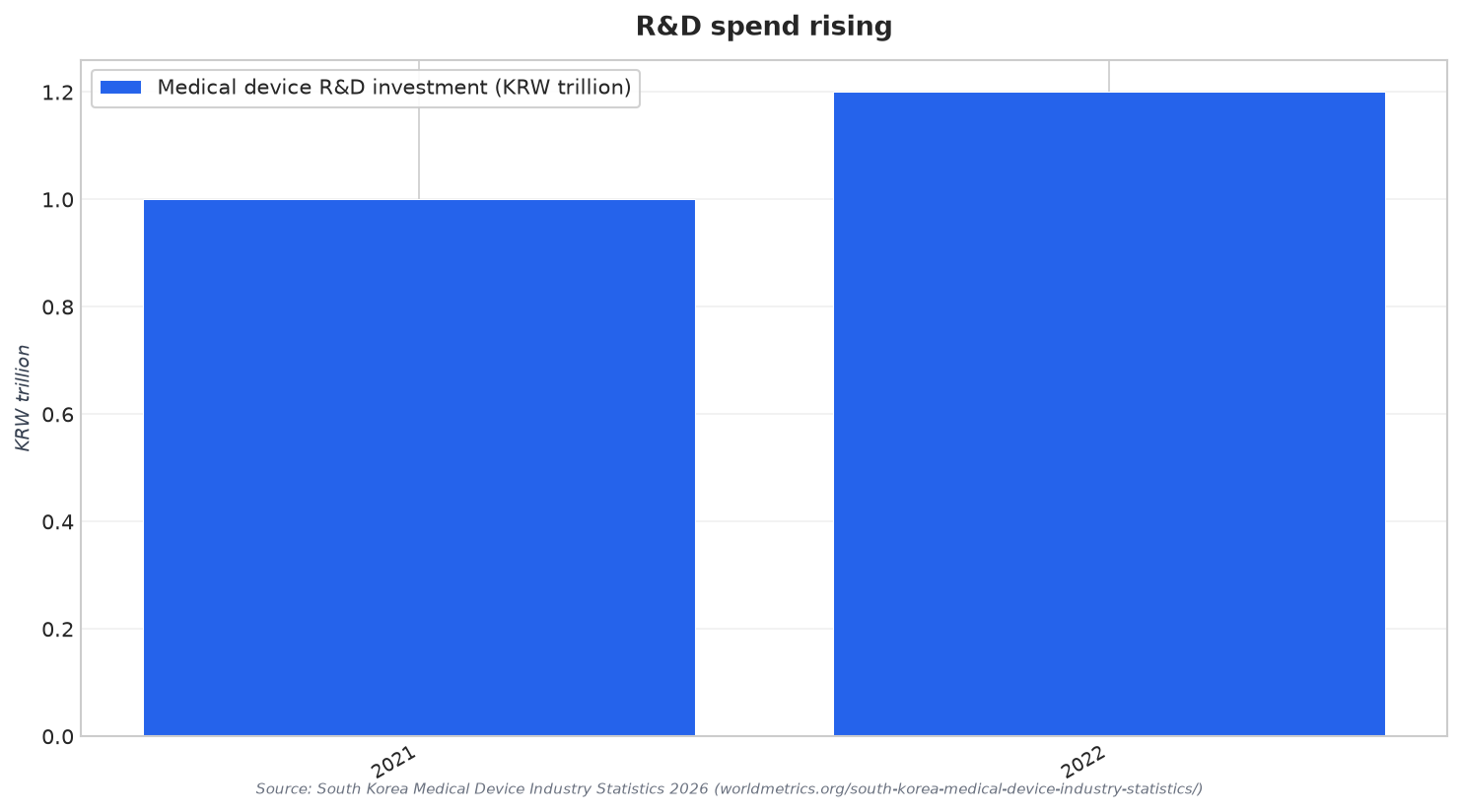
Medtech R&D investment in South Korea is increasingly showing up in measurable industry momentum, not just strategy statements. Several datasets point to expanding R&D budgets and rising commercialization capacity. KOIMA-backed R&D investment is cited at KRW 2.8 trillion in 2022, described as 15% of revenue. Other reporting places medical device R&D investment at KRW 1.2 trillion in 2022, up from KRW 1.0 trillion in 2021, which is framed as 20% year-over-year growth. Alongside R&D, exports are also highlighted as growing, with one dataset stating exports reached 4.9 billion dollars after a 14% rise, while another reports exports worth KRW 15.3 trillion (USD 11.5 billion) in 2023 with 19.2% year-over-year growth.
This investment story matters because domestic production and domestic adoption are moving together, even as the highest-acuity settings still lean heavily toward imports. Industry statistics describe production covering 92% of domestic needs across 45,200 device types. Separately, the market is described at KRW 12.5 trillion in 2022 with a CAGR of 7.8% from 2018 to 2022, while another source values the 2022 market at KRW 14.2 trillion (USD 10.6 billion). But KOISRA highlights a key tension: in top-tier tertiary hospitals, foreign medical devices account for 88.7% of roughly 54,000 devices, and domestic penetration in high-end ultrasound imaging in these hospitals is around 21.1%. That gap is exactly where R&D intensity and faster access pathways can shift the competitive balance.
Policy And Procurement Are Reinforcing Domestic Innovation
Regulatory and reimbursement design is increasingly tied to local innovation goals. KOISRA describes a policy that compresses the market entry timeline for internationally validated innovative devices from 490 days down to as few as 80 days, enabling clinical deployment prior to formal health technology assessments. WorldMetrics also reports that MFDS approves 80% of medical device applications within 8 months, and that pre-market clinical trial requirements for class III devices range from 12–24 months. Another dataset adds that a “Digital Health Device Special Approval Pathway” introduced in 2022 reduces approval time by 30% for AI-based diagnostics. On the demand side, one report states that 92% of South Korean hospitals use at least one domestic medical device brand, up from 85% in 2020.
Digital categories show how domestic innovators are translating R&D into share, especially in software-driven segments. TS Quality & Engineering reports that digital therapeutics are 100% domestic, AI devices are 77.7% domestic, and aesthetic biomaterials are 95% domestic. It also states the medical device sector saw 7,675 products approved, certified, or reported, and notes AI approvals are up over 40% (without providing a base-year figure). More broadly, approval volumes in conventional devices are also rising, with one dataset stating MFDS approved 1,250 new medical devices in 2023, up 18% from 2022. These signals align with a domestic market that is described as stable after post-pandemic normalization of diagnostic demand, with 2024 total production reaching KRW 11.42 trillion.
Company-level results help explain why the industry narrative is shifting toward domestic capability rather than simple import substitution. Samsung Medison is cited with 22% domestic market share in ultrasound devices and annual production of 45,000 units. In AI imaging software, Lunit is reported at KRW 45 billion revenue in 2023 with 150% year-over-year growth. In diagnostics, Seegene is described as leading IVD with KRW 1.2 trillion sales in 2023, with 40% from molecular diagnostics. Taken together with the reported R&D budgets and accelerated pathways, these examples show a pattern: South Korea is building a domestic innovation engine while still targeting the hardest-to-penetrate hospital procurement ecosystems where foreign incumbents remain dominant.
What does Medtech R&D investment in South Korea suggest about domestic innovation?
How dependent are tertiary hospitals in South Korea on foreign medical devices?
How fast can innovative devices reach the South Korean market under new policy?
What evidence shows domestic companies are winning in digital medtech categories?