India’s medical device market is frequently described as being on a path from import dependence to local capability. EY values the Indian MedTech market at US$12 billion in 2023-24 and projects it could reach US$50 billion by 2030, while also noting that 80% to 85% of medical devices in India are sourced internationally and imports totaled US$8.2 billion in 2023-24. That gap is one reason the Medical Device Startup Ecosystem India is increasingly aligned with import substitution. Startups and smaller manufacturers are not only chasing demand growth; they are also trying to replace categories that are still “overwhelmingly imported,” especially imaging, electronics, and other high-value segments.
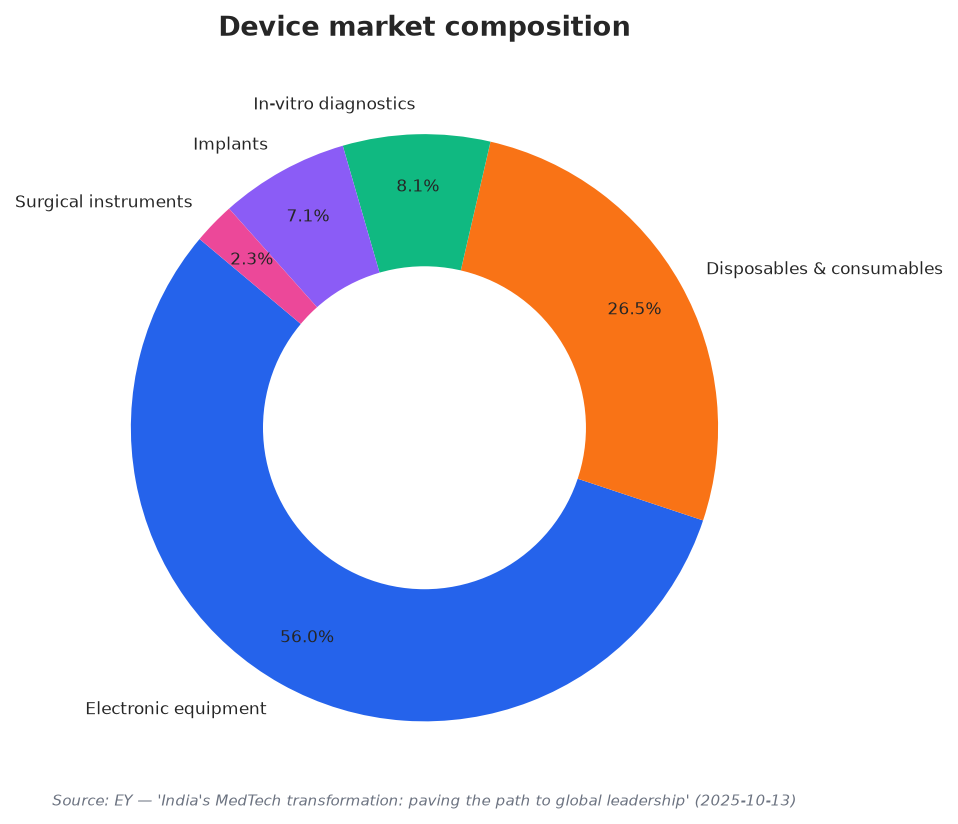
Trade data in the same EY snapshot shows why the opportunity is both strategic and complicated. Exports reached US$3.8 billion in 2023-24, with the US as the primary market, but the country still runs a sizable import bill. Segment mix also matters for founders deciding where to compete. EY breaks the market into electronic equipment (56% share), disposables and consumables (26.5%), in-vitro diagnostics (8.1%), implants (7.1%), and surgical instruments (2.3%). InsightRx similarly argues that consumables and disposables represent roughly a quarter to a third of the market and are an area where domestic players are “genuinely competitive,” while diagnostic imaging and electronics remain dominated by global majors.
PLI Plants, Device Parks, and What “Localization” Really Means
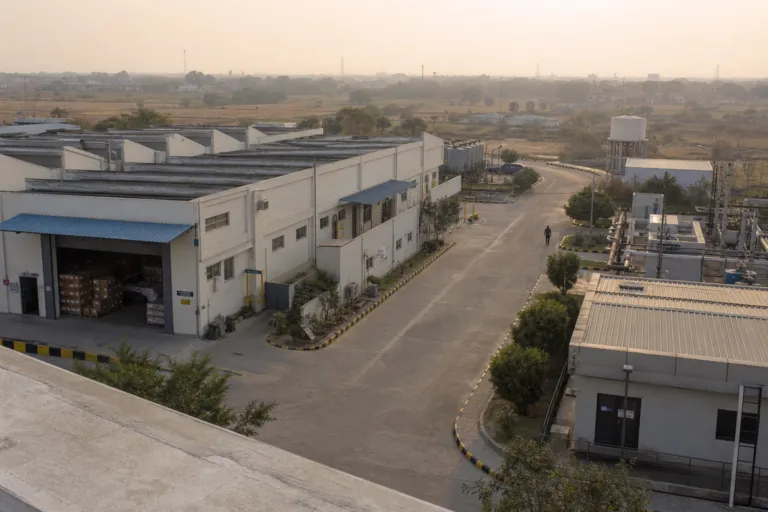
Recent manufacturing programs provide tangible proof points, but also show the limits of near-term localization. Mordor Intelligence says 22 greenfield plants commissioned under the Production-Linked Incentive (PLI) program have generated INR 12,344.37 crore (USD 1.48 billion) in sales and INR 5,869.36 crore (USD 703 million) in exports. MRFR adds that the PLI scheme committed INR 3,420 crore across four target segments—cancer care equipment, radiotherapy devices, imaging systems, and implants—tied to incremental sales thresholds. MRFR also reports that these 22 plants have displaced an estimated 11% of previously imported high-end radiotherapy and CT volume, while high-value inputs remain a constraint, with roughly 70–75% of detectors, transducers, medical-grade polymers, and precision optics still sourced abroad.
Demand signals are also shaping where startups and domestic firms can win. Mordor Intelligence estimates the India medical devices market at USD 16.97 billion in 2025 and USD 18.30 billion in 2026, projecting USD 26.66 billion by 2031 at a 7.82% CAGR. It notes hospitals accounted for 65.43% of 2025 demand, while clinics are projected to grow at a 9.43% CAGR over 2026-2031. The same source cites ICMR-INDIAB counts in 2024 of 101.3 million diabetics, 315.5 million hypertensives, and 254.2 million people with obesity, linking these needs to monitoring and therapeutic device demand. IMARC points to diabetes care devices, particularly continuous glucose monitoring systems, as the fastest-growing segment, and highlights digital integration via the Ayushman Bharat Digital Mission.
Import substitution is not only about building devices; it is also about building the commercial layer that keeps devices running. InsightRx estimates India’s medical devices market at US$12–15 billion in FY2026, growing at 12–15%, while remaining 70–80% import-dependent in value terms. It argues that the most consistent returns in Indian MedTech accrue to distribution and service, including installation and AMC annuities, which helps explain why after-sales networks can be as decisive as manufacturing. Policy voices are also pushing the ecosystem to think beyond replacing imports. At the India Medical Device 2026 event in New Delhi, Department of Pharmaceuticals Secretary Manoj Joshi urged domestic manufacturers to expand beyond import substitution, signaling that export-oriented capability will increasingly sit alongside localization goals.
What does the Medical Device Startup Ecosystem in India have to solve to enable import substitution?
What evidence is there that PLI-linked manufacturing is reducing imports?
Which product segments look more achievable for domestic players in the near term?
Where is demand concentrated in India’s medical devices market?
Is India only focusing on import substitution, or also exports?