
Hospital-at-Home India is expanding the idea of “where acute care happens” by pushing parts of the hospital experience into living rooms and local neighborhoods. The shift is happening alongside fast growth signals in home healthcare. One estimate values India’s home healthcare market at $12026.71 million in 2025 and projects it to reach $18817.77 million by 2030, a 9.4% CAGR. Another global view places home healthcare at $485.3B in 2025 and projects $504.8B in 2026, reaching $1015.8B by 2033 at a 10.5% CAGR. Together, these figures frame why providers and payers are treating home-based care as more than a post-discharge add-on.
Acute pathways still depend on hospitals, but market research increasingly describes “mixed” models that include hospital-at-home programs for selected, stable patients. Globally, the acute hospital care market is valued at USD 3,421.6 billion in 2025, with demand expected to increase to USD 3,621.4 billion in 2026 and USD 6,540.8 billion by 2036, forecasting 6.1% CAGR during 2026 to 2036 as emergency admissions and hospital-at-home programs expand across healthcare systems. Within that same report, India is projected to record 8.3% CAGR from 2026 to 2036 as private hospital networks and emergency care access expand. That combination suggests acute capacity pressures and operational resilience are pushing health systems to redesign patient flow and clinical handoffs.
Remote Monitoring and Insurance Pull Acute Care Into the Home
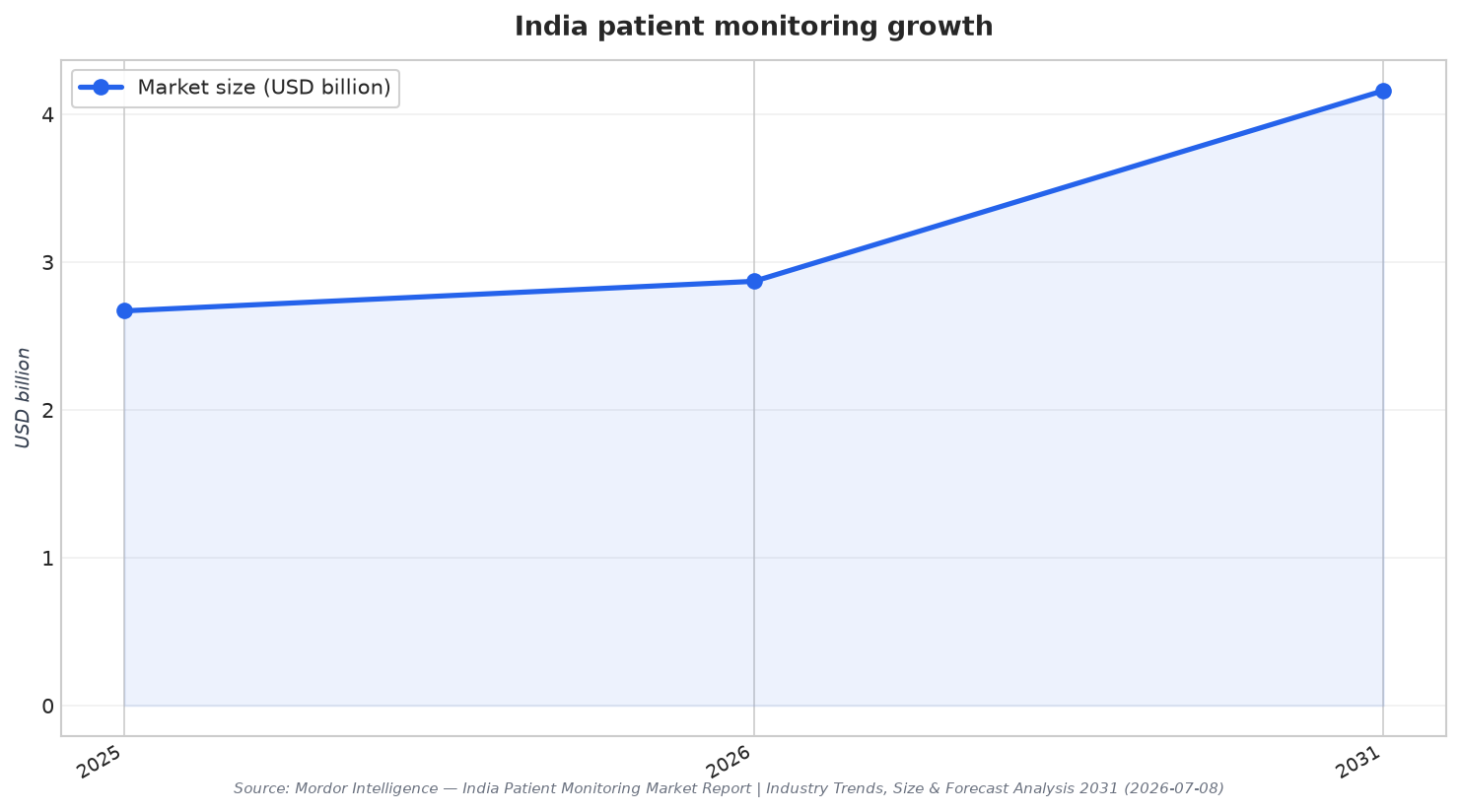
Home-based acute care depends on the ability to monitor vitals and respond quickly when a patient’s status changes. India’s patient monitoring market is expected to increase from USD 2.67 billion in 2025 to USD 2.87 billion in 2026 and reach USD 4.16 billion by 2031, growing at a 7.68% CAGR over 2026–2031. In that market, devices lead with 84.92% revenue share in 2025, while services are forecast to expand at a 9.21% CAGR through 2031. The same analysis notes that private corporate hospitals held 42.35% share in 2025, while home-healthcare providers are projected to record the highest CAGR at 9.44% through 2031. It also cites more than 100 million adults living with diabetes, reinforcing why continuous monitoring at home and in hospitals is becoming central to acute-to-home transitions.
Payers and providers are also widening access points beyond big-city campuses. In July 2024, Star Health and Allied Insurance Company expanded its offerings to include home healthcare services across more than 50 cities in India, aiming to deliver care to customers at home and improve accessibility and convenience. On the provider side, in April 2025, Aster DM Healthcare announced an investment of USD 163.9 million over the next five years to expand operations across India. The same source says this merger positions Aster among the top three hospital chains in India, with 38 hospitals and over 10,000 beds across 27 cities. These moves matter for scaling hospital-at-home-style pathways because they extend referral networks, clinician coverage, and discharge-to-home coordination across a wider geographic footprint.
As capability expands, hospital-at-home programs also rely on operational logistics and reimbursement alignment. A global home healthcare analysis highlights that favorable reimbursement policies and expanding insurance coverage for home-based healthcare services are key drivers, with governments and payers recognizing home care as a cost-effective alternative and broadening coverage for skilled nursing, therapy, and remote patient monitoring. Operationally, in September 2025, Cardinal Health expanded its Velocare at-Home Solutions business to support hospital-at-home programs by enabling logistics, supply chain, and rapid delivery of medical supplies to patients’ homes. For India, the opportunity is not just about technology. It is about stitching together monitoring, clinical workflows, and reliable supply delivery so acute care can extend beyond metro hospitals without losing clinical oversight.
What is driving hospital-at-home expansion beyond metro hospitals in India?
How large is India’s home healthcare market in recent estimates?
What does the India patient monitoring market outlook suggest for home-based acute care?
What recent moves show insurers supporting care delivery at home in India?
How does Hospital-at-Home India connect to broader acute care trends?