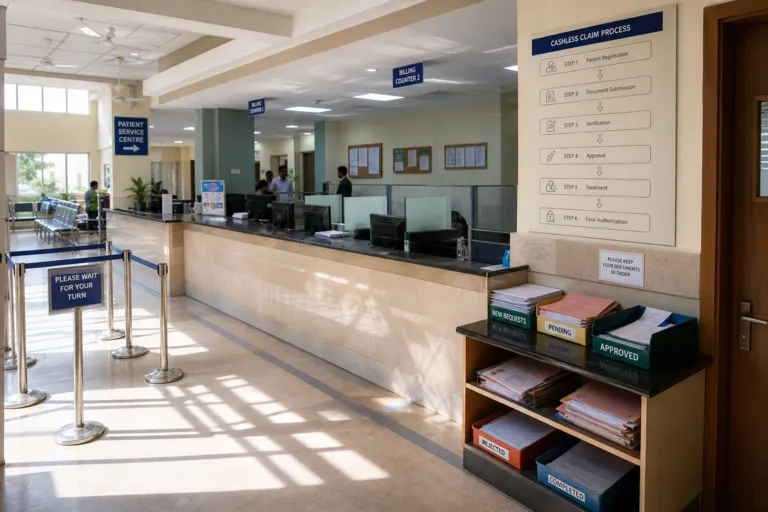
Health Insurance Technology India is increasingly defined by how quickly a claim can move from admission to discharge without paperwork bottlenecks. Mordor Intelligence expects India’s health and medical insurance market (measured by gross written premiums) to grow from USD 15.46 billion in 2026 to USD 22.86 billion by 2031, at a CAGR of 8.13% (2026–2031). In that same view of the market, digitized workflows and regulatory simplifications are highlighted as drivers that enhance accessibility, while initiatives like the National Health Claims Exchange (NHCX) are positioned as levers to improve transparency and reduce turnaround times. The direction of travel is clear: build interoperable, standardized claims processing so cashless care works more consistently across hospitals and insurers.
Private insurers and digital distribution are adding momentum because their operating model depends on speed and network depth. IMARC notes private providers held a 63% share in 2025, linking that dominance to hospital tie-ups and cashless claim networks exceeding 10,000 hospitals, alongside tech-enabled policy management platforms aimed at urban and semi-urban policyholders. Mordor Intelligence also points to structural channel change: agents and brokers held 49.18% of market share in 2025, but digital and online channels are projected to post a 22.34% CAGR through 2031. As more buying, servicing, and support shifts to digital-first journeys, expectations rise for cashless claims that can be initiated, tracked, and resolved with fewer manual steps.
Why Claims Infrastructure and TPAs Matter More Now
Cashless claims do not run on insurer apps alone; they rely on coordinated administration and standardized data exchange. Mordor Intelligence describes government-led rails such as ABHA identity creation and NHCX claims routing as mechanisms that foster interoperability between hospitals and insurers, enabling consistent claims processing. In parallel, the TPA layer is expanding as insurers outsource approvals, cashless coordination, and post-discharge verification to improve operational efficiency. NextMSC values India’s health insurance TPA market at USD 6.63 billion in 2024 and expects it to reach USD 13.33 billion by 2030, at a CAGR of 11.68%. With TPAs central to claims adjudication, benefits administration, and hospital network management, their growth signals how much of the cashless experience is being industrialized.
Automation is also becoming a stated priority across the broader insurance sector, strengthening the case for faster, rules-based claims. IBEF says the insurance market in India is expected to reach US$ 222 billion by 2026, and adds that Robotic Process Automation (RPA) and AI will occupy center stage, with bots becoming mainstream in front- and back-office workflows to automate policy servicing and claims management. That theme aligns with Mordor Intelligence’s emphasis on API-driven issuance models that streamline processes by reducing manual inputs and improving distribution efficiency. Taken together, these shifts suggest the industry is building end-to-end digital plumbing where cashless claims are not treated as exceptions, but as repeatable, auditable workflows.
The market context helps explain why cashless readiness is becoming a competitive requirement rather than an add-on. Cervicorn Consulting estimates India’s health insurance market at USD 109.67 billion in 2025 and projects USD 348.27 billion by 2035, at a CAGR of 12.25% (2026–2035). The same source points to PM-JAY as a major government initiative and notes the program aims to offer free health coverage to more than 500 million economically disadvantaged Indians. It also cites Niva Bupa’s early-2024 announcement to increase its network of cashless hospitals and invest in digital claim processing, underscoring how network expansion and digitized claims are being used as visible growth strategies. As cashless scale expands, technology and standards will increasingly decide who delivers the smoothest hospital-to-insurer settlement.
What signals a shift toward cashless claims in India’s health insurance market?
How large is the cashless network advantage for private providers?
What is the growth outlook for India’s health insurance TPA market tied to claims operations?
How does Health Insurance Technology India connect to interoperability and faster processing?
What role do automation tools play in claims and servicing?