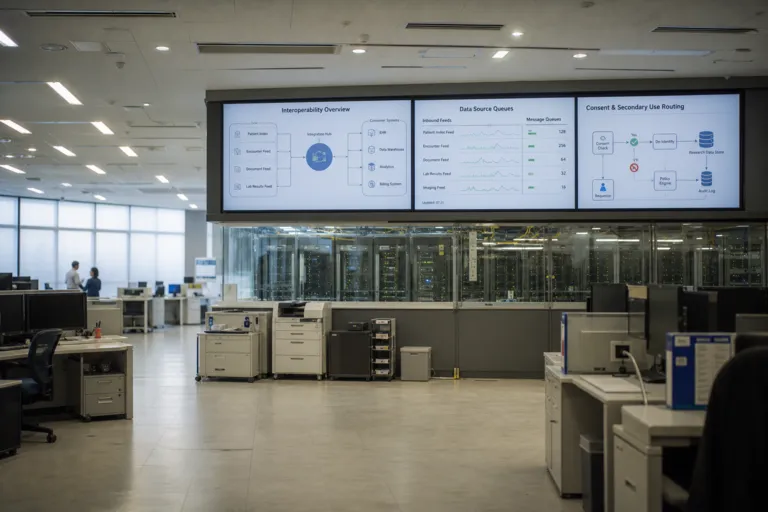
Health Data AI Reform Japan is best understood through the country’s Healthcare DX direction. Japan’s Ministry of Health, Labour and Welfare defines Healthcare DX as a system that ties data across prevention, treatment, prescriptions, billing, care coordination, and research, while also enabling secure secondary use via cloud-based standardization. That distinction between primary use for direct care and secondary use for research, AI development, and drug discovery matters for clinical research access. It frames a shift from data being trapped in silos to data being prepared for controlled reuse, where the same clinical information can support wider innovation without losing sight of security and appropriate governance.
Market signals suggest why the pressure is rising now. One Japan-focused report says the AI in healthcare market reached USD 1.42 billion in 2024 and is forecast to reach USD 14.8 billion by 2033, with a CAGR of 36.5% during 2025–2033. The same source also ties adoption urgency to demographics, stating Japan has about 36.2 million people aged 65 or older, representing 29.4% of its population. It adds that buying decisions increasingly depend on data control, integration, cyber resilience, and evidence of payback. For research stakeholders, those criteria translate into practical access questions: who can use data, in what format, under what controls, and with what validation and monitoring once AI touches routine workflows.
Interoperability Is Becoming the Gatekeeper for Research Access
Clinical research access depends less on “more data” and more on usable exchange standards and shared models. A Japan health information exchange briefing highlights key technology areas such as HL7 FHIR, cloud-based HIE, healthcare APIs, electronic medical-record integration, healthcare cybersecurity, AI-enabled data utilization, synthetic medical data, and common data models such as OMOP. It also points to emerging opportunities in Japan that include electronic medical-record interoperability, FHIR implementation, healthcare-long-term-care data exchange, real-world-data platforms, clinical research applications, healthcare cybersecurity, and secondary use of medical data. Taken together, this describes a path where research teams may gain broader access not by copying entire databases, but by relying on interoperable exchange, standardized representations, and security controls that keep secondary use viable.
Analytics growth reinforces the same theme: data must be integrated before it becomes research-ready. Another Japan market report states the healthcare analytics market reached USD 2.40 billion in 2024 and is expected to reach USD 15.10 billion by 2033, growing at a CAGR of 19.8 during 2025–2033. It links demand to rapid adoption of electronic health records, hospital information systems, and cloud-based healthcare platforms that generate vast amounts of clinical data. It also notes that in November 2025, BC Platforms continued expansion of AI-native healthcare analytics capabilities for precision medicine initiatives, supporting Japanese healthcare and research institutions through advanced federated data analysis technologies and strengthening use of harmonized healthcare datasets for genomic and clinical research applications. Federated approaches and harmonized datasets can directly affect how researchers access data while keeping data control and governance in focus.
Access also changes when tools are designed to streamline operational bottlenecks around trials, screening, and enrollment. A Japan AI in healthcare market profile notes that RapidAI received Class III Shonin clearance in Japan in November 2023, enabling launch of its Rapid Edge Cloud platform and a non-contrast CT tool for stroke identification. The same profile says RapidAI provides a clinical trial platform to streamline screening and enrollment. While this is one company example, it illustrates how reforms that prioritize secure data sharing, integration, and monitoring can translate into concrete research workflows. The nearer-term implication is not simply faster AI demos, but clearer governance, interoperability choices (such as FHIR and common data models), and cybersecurity controls that make secondary use credible enough to expand clinical research access.
What does Japan’s Healthcare DX definition imply for clinical research access?
Which interoperability approaches are being highlighted for Japan’s data exchange and research use?
What do market forecasts suggest about the momentum behind Health Data AI Reform Japan?
Why are data control and cybersecurity central to AI deployment decisions in Japan?
Is there an example of a tool in Japan that connects AI with clinical trial workflows?