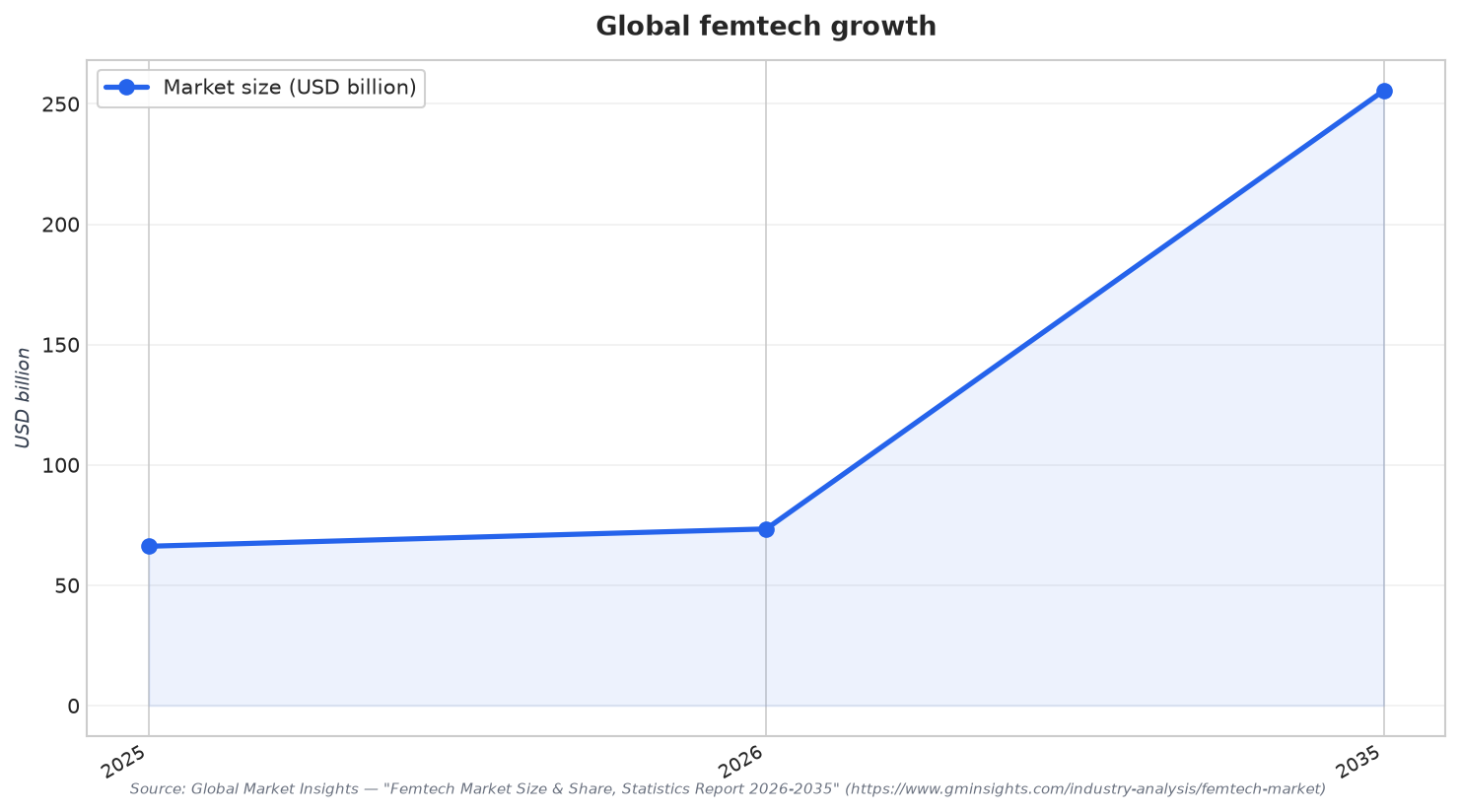
Femtech is expanding from niche wellness tools into products and services that resemble everyday healthcare. Globally, Global Market Insights estimates the femtech market at USD 66.2 billion in 2025, projecting growth from USD 73.4 billion in 2026 to USD 255.5 billion by 2035 at a 14.9% CAGR. The Business Research Company also points to scale, forecasting the global femtech market reaching $118.99 billion by 2030 at 20.8%. For Femtech Women’s Health Indonesia, these global figures matter as context: they indicate that solutions like period tracking, fertility support, prenatal and postnatal care products, and broader reproductive healthcare are increasingly treated as standard categories rather than experiments.
Indonesia has a specific structural tailwind that can pull femtech closer to routine care: reimbursement. Market Research Future reports that Indonesia’s BPJS Kesehatan expanded prenatal telehealth reimbursement to 185 million beneficiaries in 2024. That detail is important because it shifts digital pregnancy support from “nice to have” to “possible to scale,” especially when paired with care delivery partners. International examples show how partnerships can operationalize this approach. Grand View Research notes that strategic partnerships help address unmet needs, citing an August 2021 example where the pregnancy app Babyscripts partnered with Privia Health to improve maternal care delivery. The model translates well to an Indonesia context where payers and providers can define what “mainstream” looks like.
What “Mainstream” Looks Like: From Devices to Clinics
Market segmentation signals that femtech is not only app-first. Grand View Research reports that devices led type share in 2024 with 33.33% revenue share, while pregnancy and nursing care dominated application share in 2024 at 17.72%. Mordor Intelligence frames a similar direction with different estimates: devices commanded 51.62% share in 2025, hospitals and maternal centres held 46.10% of revenue share in 2025, and pregnancy and nursing care accounted for 31.05% of market size in 2025. These figures are global, not Indonesia-specific, but they show a consistent pattern: the fastest path into mainstream care often runs through clinical workflows, institutional purchasing, and validated devices, not only direct-to-consumer downloads.
Indonesia’s consumer health market adds another clue about how women’s health becomes “normal.” In feminine care, IndexBox forecasts the mainstream segment (national value plus mass brands) will keep 65–70% of volume, even as premium and natural lines expand. It also expects e-commerce to capture 30–35% of urban value by 2035, and reusable products to remain below 5% volume share even by 2035 due to sticky disposable habits. Pricing ranges show a wide ladder: ultra-value private label packs at around IDR 4,000–6,000 for 8–10 pads, mainstream mass brands at IDR 12,000–18,000, and premium natural or organic lines at IDR 25,000–40,000. This mix suggests that “mainstream” in Indonesia often means high-access, mass distribution, and clear value tiers—conditions that femtech companies can mirror through affordable entry points and trusted channels.
Momentum is also visible in capital and product direction, which can influence how quickly solutions professionalize. Market Research Future says private investment in the femtech market more than tripled between 2019 and 2024, and cites Silicon Valley Bank recording USD 2.8 billion in dedicated women’s health funding rounds in 2024 versus under USD 800 million in 2019. Mordor Intelligence similarly cites USD 2.6 billion of women’s health funding in 2024. While those funding numbers are not Indonesia-only, they help explain why more companies are building clinical-grade devices, telehealth services, and prescription-aligned models. In Indonesia, the combination of BPJS-backed prenatal telehealth reimbursement and scalable digital commerce could help women’s health technology move from isolated use into everyday care pathways.
What is pushing women’s health tech toward mainstream care in Indonesia?
How big is the global femtech market according to the sources?
Which femtech segments lead globally: devices or apps?
What does feminine care in Indonesia suggest about adoption pathways for Femtech Women’s Health Indonesia?