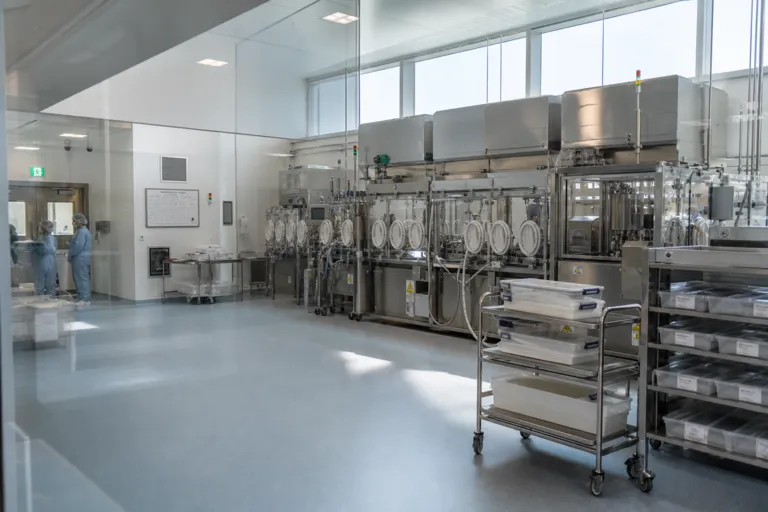
Biologics manufacturing in South Korea is increasingly framed around global supply readiness. In biologics contract manufacturing, South Korea accounted for 3.5% of the global market in 2024 (revenue share). In the contract development and manufacturing organization (CDMO) segment, South Korea accounted for 0.6% of the global market in 2024 (revenue share). These two reference points show that the country participates in both manufacturing-only outsourcing and broader CDMO programs, even as global revenue leadership in future outlooks is expected to remain with the U.S., and China is projected to lead Asia Pacific by revenue in multiple outlooks.
Within the broader biologics manufacturing market, one dataset places South Korea at approximately 14.3% of the Asia-Pacific market in 2025, valued at around USD 1,297.5 million. The same global view sizes the total biologics manufacturing market at USD 41,245.8 million in 2025 and projects USD 89,681.0 million by 2035, with a CAGR of 8.08% from 2026 to 2035. This context matters for supply planning because commercial manufacturing is described as the largest-share segment, supported by capacity expansion by biopharmaceutical companies and CDMOs for global product distribution.
Policy, Portfolio Mix, and the Shift Toward Faster Biologics Execution
Domestic market signals also reinforce the manufacturing scale-up narrative. The Korea pharmaceutical market is expected to grow from USD 23.19 billion in 2025 to USD 23.74 billion in 2026 and reach USD 26.69 billion by 2031, at a 2.37% CAGR over 2026–2031. In that same view, biologics are moving at a 3.72% CAGR to 2031, while small molecules account for 67.42% of market size in 2025. The report also states government funding for biomedical R&D climbs 15% in 2025, and references the 2023 “Bio Economy 2.0” plan lifting biopharma funding to 36.7 billion won in 2025.
At the technology and product level, South Korea’s CDMO outlook highlights how portfolios can shape global supply. The market is expected to reach US$ 243.4 million by 2033, with a CAGR of 9.2% from 2025 to 2033. Monoclonal antibodies (mAbs) were the largest revenue generating product in 2024, while nucleic acid therapeutics are described as the most lucrative segment with the fastest forecast growth. In biotechnology overall, South Korea accounted for 1.7% of global revenue in 2023, and the local biologics market is described as the fastest growing in-country, linked to flexible manufacturing facilities using disposables, new cell culture techniques, fast track GMP facilities, and attempts for continuous manufacturing.
Global supply reliability also depends on upstream inputs, and South Korea’s API base is projected to grow. The South Korea API market is valued at USD 1,200 million in 2025 and is projected to reach USD 1,720 million by 2030 at a 7.5% CAGR, outpacing a stated global growth rate of 6.6%. The same source positions South Korea as a critical pharmaceutical manufacturing hub in Asia Pacific and links demand to specialty and biosimilar APIs. Taken together, these indicators support a practical view of Biologics Manufacturing South Korea as a system: outsourced biologics capabilities, faster-growing biologics vs the wider pharma baseline, and API expansion that can strengthen end-to-end export execution.
What share of global biologics contract manufacturing did South Korea hold in 2024?
How fast is South Korea’s biologics CDMO market expected to grow?
How is South Korea positioned in the Asia-Pacific biologics manufacturing market?
What policy and funding signals support biologics scale-up in South Korea?
How does the API outlook relate to scaling biologics supply from South Korea?