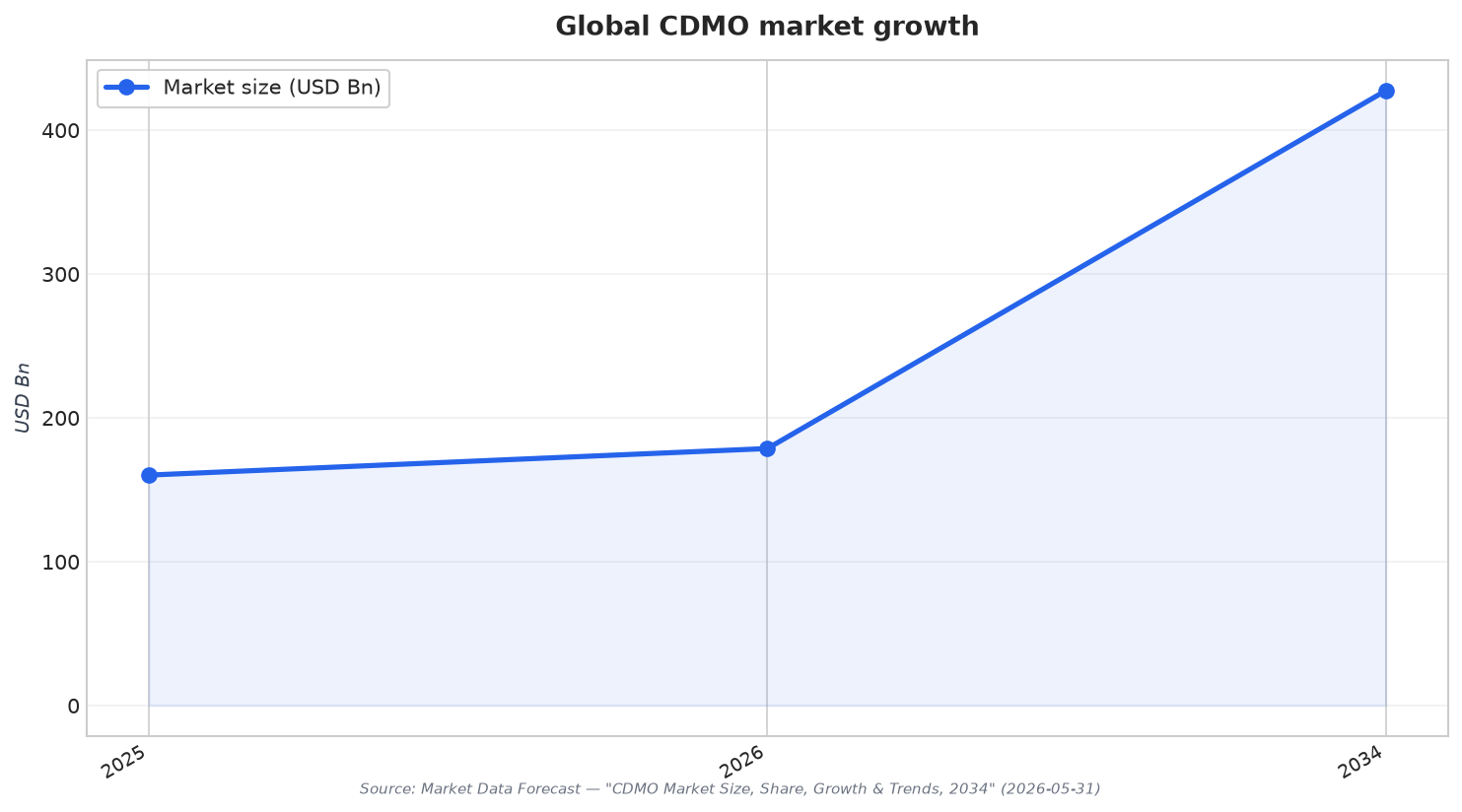
CDMO Pharma Outsourcing Singapore is gaining visibility as drug sponsors reshape supply networks for speed, flexibility, and risk control. Globally, the CDMO market was valued at USD 160.25 billion in 2025, estimated at USD 178.71 billion in 2026, and projected to reach USD 427.54 billion by 2034, with a CAGR of 11.52% (2026–2034). This growth aligns with rising molecule complexity and the push for specialized capabilities, including cell and gene therapies and mRNA-based candidates. In parallel, supply-chain concentration remains a theme in global sourcing, with China and India supplying more than 65% of global pharmaceutical intermediates, a fact that keeps diversification and secondary sourcing on executive agendas.
Asia Pacific is part of that outsourcing shift, and Singapore is explicitly included among the markets building flexible manufacturing networks. The Asia Pacific pharmaceutical CDMO market was estimated at USD 74.04 billion in 2025 and is predicted to reach around USD 156.91 billion by 2035, expanding at a CAGR of 7.80% from 2026 to 2035. In 2025, finished dosage formulation (FDF) development and manufacturing led service share at 44%, followed by API manufacturing at 41% and secondary packaging at 15%. The same dataset shows late-stage demand: Phase III held a 32% share in 2025, with Phase II at 20%, pre-clinical at 18%, and Phase IV at 16%. For Singapore-based teams, these regional mixes matter because they map directly to where sponsors outsource work and where cross-border supply lanes need dependable quality and documentation.
Why Singapore Fits the New Outsourcing Playbook
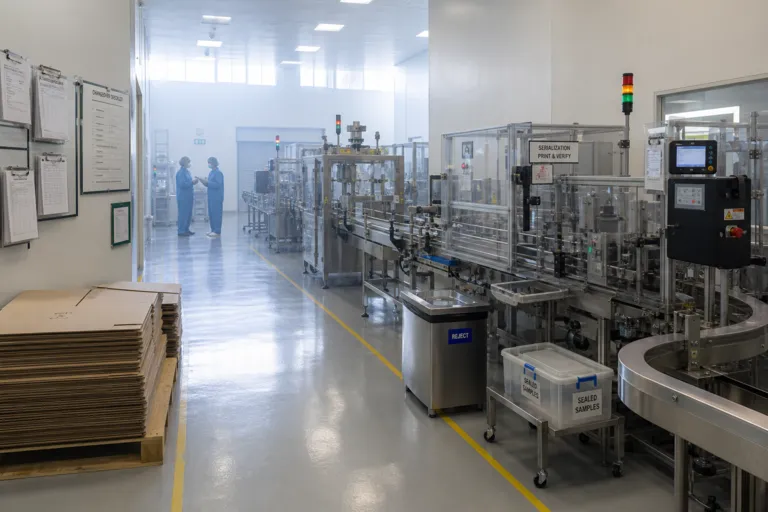
Singapore’s positioning is often framed around targeted CDMO and supply-chain services rather than broad, low-cost bulk production. IndexBox notes opportunities for CDMOs in sterile fill-finish, secondary packaging with serialization, and stability testing, particularly for biologics destined for regional markets, supported by the country’s strong regulatory reputation. The same source describes how value creation for distributors and logistics providers shifts toward integrated services, including regulatory documentation, cold-chain management, inventory financing, and data-rich supply chain solutions for hospitals and pharmacies. It also argues Singapore’s hub role is likely to strengthen, evolving from a distribution center into a base for precision medicine logistics, clinical trial supply management, and real-world data analytics linked to pharmaceutical outcomes.
Demand-side behavior inside Singapore also reinforces resilience objectives. IndexBox’s Singapore pharmaceutical intermediates coverage highlights “CDMO-led demand consolidation,” where outsourcing for formulation development and manufacturing concentrates purchasing into technically sophisticated buying centers that prioritize suppliers with strong regulatory support and flexible supply terms for clinical-stage materials. The same report emphasizes “supply chain resilience over pure cost optimization,” noting that manufacturers and CDMOs in Singapore are diversifying sources and placing greater value on transparent, auditable supply chains and robust quality systems, even at a cost premium. It also points to regulatory harmonization pressures, where buyers insist on compendial status (USP/EP/JP) and supporting regulatory filings (DMF, CEP) accepted across jurisdictions—requirements that directly influence supplier qualification, packaging controls, and release timelines.
Global outsourcing metrics help explain why integrated CDMO models and regional siting matter. Global Market Insights estimates the pharmaceutical CDMO market at USD 173.7 billion in 2025, projecting growth from USD 184.9 billion in 2026 to USD 342 billion by 2035 at a 7.1% CAGR. In that same report, contract manufacturing services represented 48.7% of global pharmaceutical CDMO revenue in 2025. It also cites finished-dose outsourcing reaching 65% in 2025, and notes high outsourcing engagement in bioprocessing platforms, with 77.5% of mammalian and 78% of microbial fermentation facilities engaged in some form of outsourcing activity. Capacity additions are also part of the context: one report cites AstraZeneca’s planned USD 1.5 billion manufacturing project in Singapore, with impact that may not be fully realized until 2028 or later, while sponsors adopt dual-sourcing strategies to reduce scheduling and supply risks.
How does CDMO pharma outsourcing in Singapore strengthen regional supply chains?
What are the key outsourcing service shares in Asia Pacific CDMO markets?
Which research phases drive outsourcing demand in Asia Pacific CDMOs?
What do global CDMO market figures suggest about outsourcing momentum?
What investment signal is cited for manufacturing capacity in Singapore?