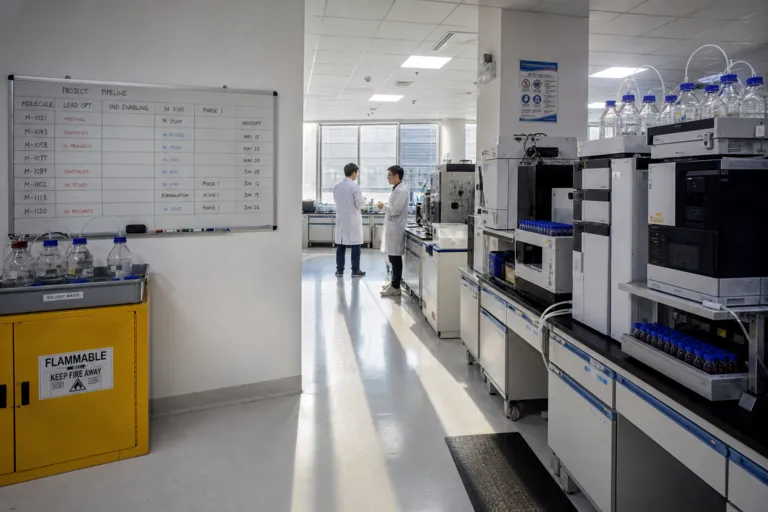
AI Drug Discovery China is no longer just about new algorithms in academic settings. It is increasingly measured by pipeline disclosures, investigational clearances, and clinical-stage progress. By mid-2026, at least 12 AI-discovered or AI-optimised drug candidates are reported to be in clinical trials in China, with three having reached Phase II or beyond. That is a meaningful sign of translation from computation and screening into human testing, even as the same disclosures caution that costs outside discovery, such as clinical trials and manufacturing, remain substantial regardless of how the drug was discovered.
Company-level timelines also show how AI and lab execution are being paired to compress early discovery and selection work. Insilico Medicine’s CEO said the company has reduced the time needed to produce some drug development candidates to about one year by combining AI with laboratory research in China. The fastest program reached candidate nomination in nine months, while the typical timeline is about 13 months. In the same comparison, conventional approaches were described as usually taking about four-and-a-half years to reach the same stage, with the timeline covering early discovery and candidate selection rather than the full process to commercial launch.
What China’s Pipeline Signals—and What Still Slows Scale
Pipeline depth and regulatory progress matter as much as speed. Insilico has said it produced 31 preclinical candidates and secured 13 investigational new drug clearances, enabling advancement toward human studies, while noting that none of its experimental medicines has received commercial approval. A separate 2024 analysis of AI-native biotechnology pipelines reported Phase I success rates of between 80% and 90%, and a Phase II success rate of about 40%; the researchers noted the analysis was based on publicly reported pipelines and did not compare otherwise identical AI-supported and conventional programs. These details frame momentum while also highlighting why clinical evidence remains the key test.
Market outlooks and capital formation add another layer to the shift from lab to pipeline. Grand View Research’s horizon outlook projects China to be the fastest growing regional market in Asia Pacific and to reach USD 808.8 million by 2030, with China projected to lead the region in revenue that year. On funding and scaling, DrugPatentWatch reported Insilico Medicine’s IPO on the Hong Kong Stock Exchange in late 2025 raised nearly USD 300 million. These figures point to growing financial support around clinical translation and infrastructure, not just experimentation.
Still, the path from pilot projects to repeatable pipelines depends on data, integration, and governance. Roots Analysis highlights that the lack of consistent regulatory guidelines can restrict AI adoption across drug discovery pipelines, citing concerns around data security, privacy, and intellectual property protection for proprietary biomedical and chemical data. The same analysis notes data integration complexities, with fragmented genomics, proteomics, and preclinical assay data stored in different formats, which can hinder multi-omics processing and actionable insights. Even as platforms increasingly deploy generative AI and deep learning-based platforms with reinforcement learning to design novel molecules, these constraints shape how quickly AI can scale across discovery portfolios.
How many AI-discovered drug candidates are in clinical trials in China?
How fast can AI-assisted teams reach candidate nomination compared with conventional approaches?
What does the market outlook suggest for China’s AI in drug discovery revenue?
What are key obstacles that can limit AI adoption in drug discovery pipelines?
What does the reported pipeline data say about AI drug discovery in China moving from lab to pipeline?