
Issues
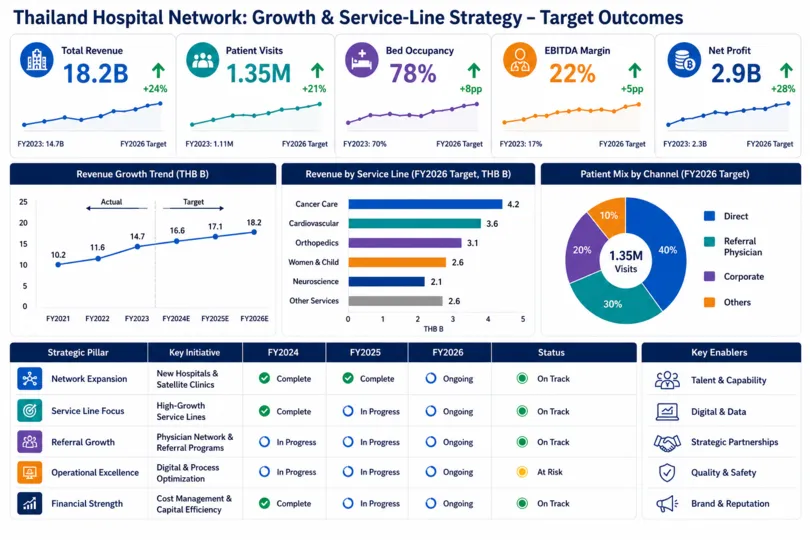
The client operated a network of private hospitals and outpatient facilities in Thailand. Competition was increasing across specialist care, preventive health, and internationally oriented medical services, while several facilities had uneven utilization and overlapping service portfolios. Management needed to identify which specialties, patient segments, and locations offered the strongest growth potential. The strategy also needed to balance domestic demand, international patients, clinical capability, and the investment required to maintain high service standards. Thailand continues to support a substantial private-hospital and healthcare ecosystem.
Solution
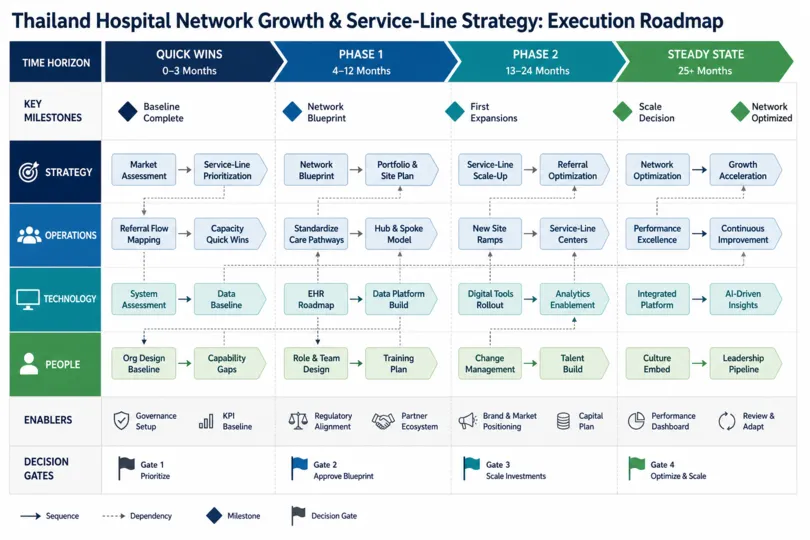
We created a network growth and service-line strategy based on catchment analysis, patient flows, referral patterns, demographic demand, competitor capacity, clinical capabilities, and facility performance. The work evaluated specialist outpatient services, rehabilitation, preventive care, day procedures, and selected high-complexity specialties. Each option was assessed against demand, investment, workforce availability, referral potential, and fit with the broader hospital network. A phased roadmap aligned service development with capacity and operational readiness.
Approach
Our hospital growth program included:
- Analyzing catchment populations and patient-demand patterns.
- Reviewing service utilization, referrals, and patient leakage.
- Mapping competitor facilities, specialties, pricing, and positioning.
- Interviewing patients, physicians, insurers, and referral partners.
- Assessing clinical capabilities and workforce requirements.
- Comparing expansion, partnership, and service-development scenarios.
Recommendations
We proposed a targeted strategy rather than broad capacity expansion:
- Prioritize rehabilitation and specialist outpatient services with strong unmet demand.
- Expand day-care capacity before investing in additional inpatient beds.
- Create clearer roles for each hospital within the network.
- Strengthen physician-referral relationships across priority service lines.
- Develop differentiated propositions for domestic and international patient segments.
- Introduce network dashboards covering utilization, referrals, retention, and service-line performance.
Engagement ROI
The recommendations reduced the client’s planned capital requirement by approximately 20% by redirecting investment toward outpatient and day-care services. Two priority service lines achieved patient volumes 16% above the original forecast during their first year. Improved referral coordination reduced leakage to competing providers by 10%, while clearer facility roles improved the use of existing diagnostic and clinical capacity. The strategy enabled the hospital group to pursue growth through focused service development rather than costly, broad-based expansion.