
Issues
The client was a global pharmaceutical company preparing to introduce a specialty treatment in Indonesia. The organization needed to understand eligible patient demand, diagnosis and referral pathways, specialist concentration, reimbursement conditions, hospital access, and distribution requirements. Indonesia’s national health-insurance environment and geographically dispersed provider landscape also created important questions around pricing, account prioritization, and commercial coverage. The client required a launch strategy that could balance patient access, investment, and commercial potential.
Solution
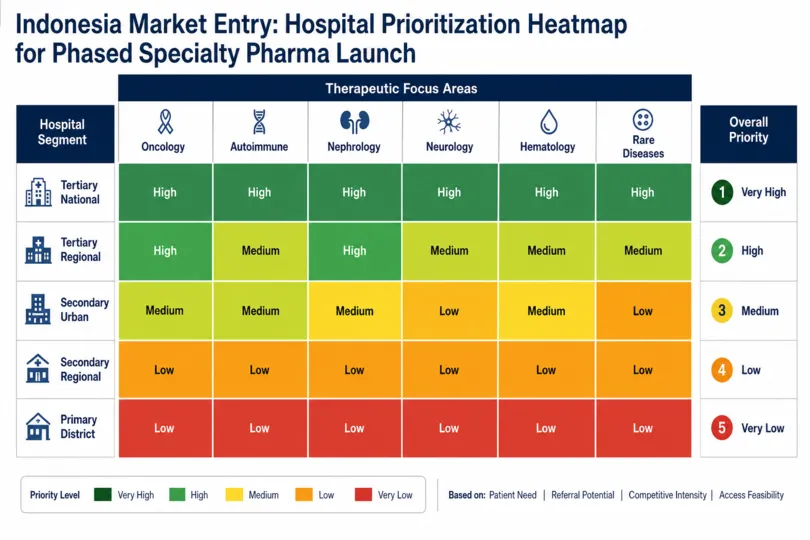
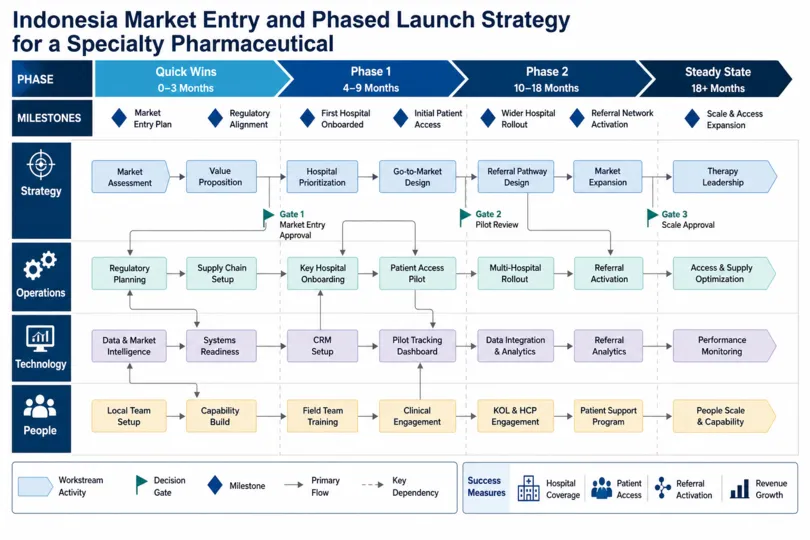
We developed an Indonesia-specific market-entry and launch strategy covering patient-potential modeling, treatment pathways, reimbursement, hospital segmentation, prescriber behavior, competitive positioning, and route-to-market design. The solution identified priority referral hospitals, specialist groups, and patient segments, while assessing the roles of national accounts, private hospitals, and regional distribution. We also developed differentiated value propositions, partner-selection criteria, launch-readiness requirements, and a phased commercial roadmap aligned with the client’s available resources.
Approach
Our pharmaceutical launch assessment included:
- Modeling eligible patient populations and expected treatment uptake.
- Mapping diagnosis, referral, prescribing, and follow-up pathways.
- Interviewing specialists, hospital stakeholders, payers, and distributors.
- Assessing pricing, reimbursement, procurement, and access requirements.
- Benchmarking competing treatments, positioning, and launch models.
- Evaluating distributor-led, direct, and hybrid commercialization options.
Recommendations
We recommended a focused launch model designed around priority institutions and specialists:
- Begin with major referral hospitals in Java before expanding coverage nationally.
- Concentrate medical engagement on specialists managing the highest patient volumes.
- Develop separate value propositions for clinicians, hospitals, and reimbursement stakeholders.
- Retain direct control over medical strategy, pricing, and strategic accounts.
- Appoint a local partner with strong regulatory, distribution, and regional support capabilities.
- Expand into additional cities only after defined adoption and access milestones were achieved.
Engagement ROI
The strategy reduced the proposed first-phase commercialization budget by an estimated 17% through more focused market and customer prioritization. The client identified 32 priority hospitals representing the majority of the initial addressable opportunity and shortened launch preparation by approximately three months. Early partner assessment also uncovered gaps in regional coverage and specialist engagement before the distribution agreement was finalized. Overall, the engagement created a clearer route to launch, strengthened internal alignment, and established a practical foundation for expansion in Indonesia.