
Issues
A digital health company planned to introduce a remote chronic-care platform in Singapore. Although providers showed early interest, the company had not fully validated clinical workflows, user adoption, data governance, interoperability, regulatory classification, or the willingness of institutions to fund the solution. Singapore has an advanced digital-health environment, alongside defined requirements and guidance for software-based medical devices, AI-enabled healthcare technologies, and healthcare data integration. The client needed a commercialization model based on measurable provider and patient value.
Solution
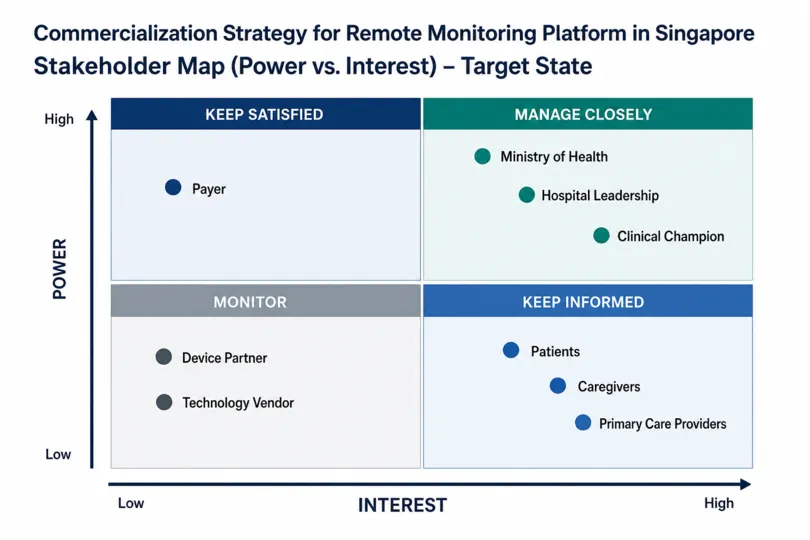
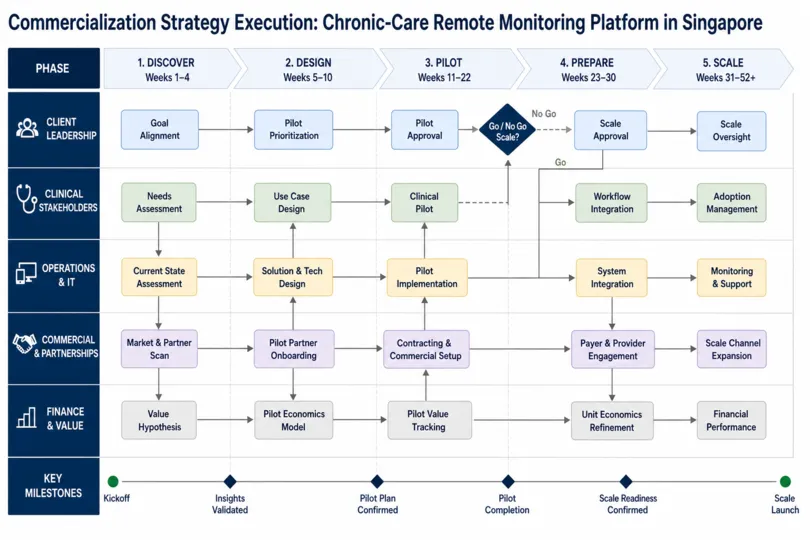
We designed a commercialization strategy combining patient and clinician research, workflow analysis, regulatory assessment, partner mapping, pricing, and business-model evaluation. The work tested the platform’s value proposition with healthcare providers, patients, insurers, and employers. We identified priority chronic-care use cases, clarified integration and localization requirements, and compared provider-funded, insurer-supported, employer-sponsored, and subscription models. A pilot framework defined target partners, adoption measures, clinical workflows, and criteria for future scale.
Approach
Our digital health assessment involved:
- Mapping patient journeys and clinical workflows.
- Interviewing patients, clinicians, providers, insurers, and employers.
- Evaluating user needs, trust factors, and adoption barriers.
- Reviewing regulatory classification and data requirements.
- Assessing interoperability and institutional integration needs.
- Comparing partnership, pricing, and revenue models.
Recommendations
We proposed a provider-led commercialization strategy focused on demonstrated outcomes:
- Start with two chronic-care use cases where remote monitoring addressed clear operational needs.
- Position the platform around continuity of care, engagement, and clinical efficiency.
- Integrate onboarding into existing provider workflows.
- Establish clear clinical-governance and escalation protocols.
- Build evidence through controlled institutional pilots before wider commercialization.
- Use provider and insurer partnerships rather than beginning with direct-to-consumer expansion.
Engagement ROI
The redesigned pilot increased patient enrollment by 32% compared with the company’s earlier test program. Streamlined workflows reduced care-team onboarding time by 27%, while active-patient retention improved by 17% over six months. The engagement also created a qualified pipeline involving nine healthcare providers and insurers. By focusing investment on institutional adoption and validated care pathways, the company reduced planned customer-acquisition spending and developed a stronger commercial case for scaling the platform in Singapore.